
Westport’s Street Railway Wars
Posted on December 24, 2025 by Jenny ONeill
By Jenny O’Neill, Westport Historical Society
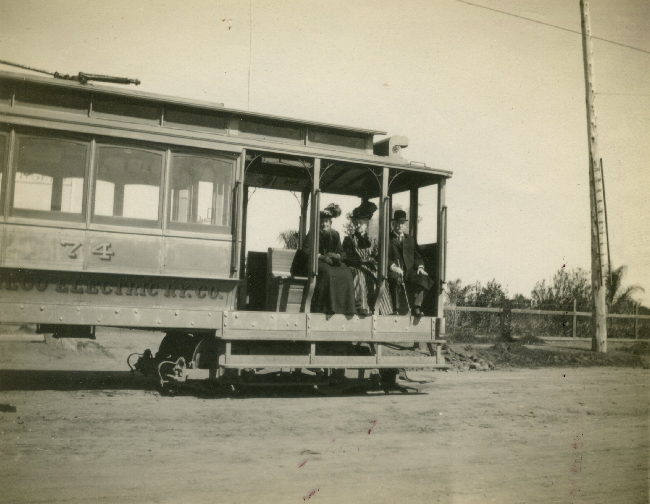
Photograph of the trolley at The Narrows WHS 2022.014.078
A recent donation to the collection of the Westport Historical Society prompted a re-examination of the street railway system (electric powered trolleys) that once connected Southcoast communities. The early 1900s was an era of trolley lines and ambitious but doomed plans to connect Horseneck Beach to Fall River and New Bedford by street railways.
Aspects of this story are represented by several documents in our collection:
- Correspondence between Abraham Manchester and Niles Car and Manufacturing Company, Ohio
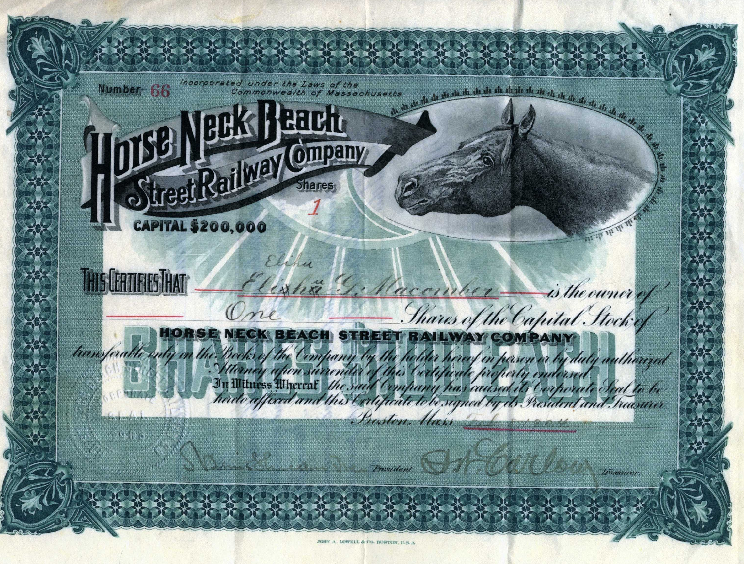
- A share certificate for the Horseneck Beach Street Railway Company
- A publication Trolleygrams 1924, 30th Anniversary Lincoln Park
- A ledger from the Union Street Railway Co. for Tuesday, April 27th, 1897 providing a list of employees.
- Photos/postcards
If you have additional information about Westport’s street railways, please get in touch!
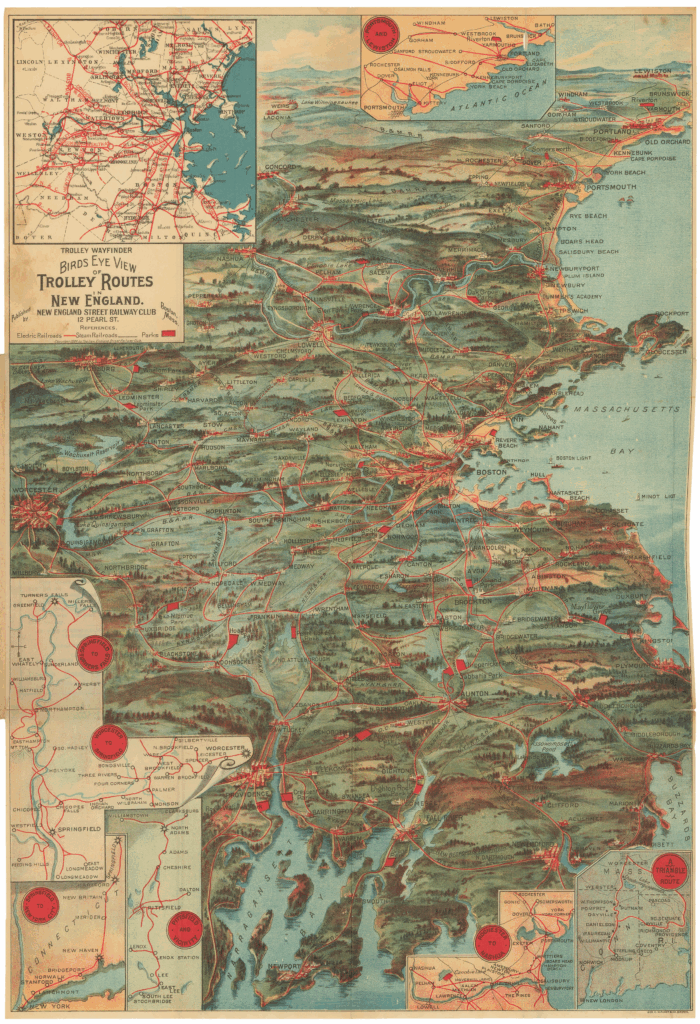
Geo. H. Walker & Co., and New England Street Railway Club. “Trolley wayfinder, birds eye view of trolley routes in New England.” Map. Boston: New England Street Railway Club, 1904–1905. Norman B. Leventhal Map & Education Center, https://collections.leventhalmap.org/search/commonwealth:jh343z12j (accessed December 24, 2025).
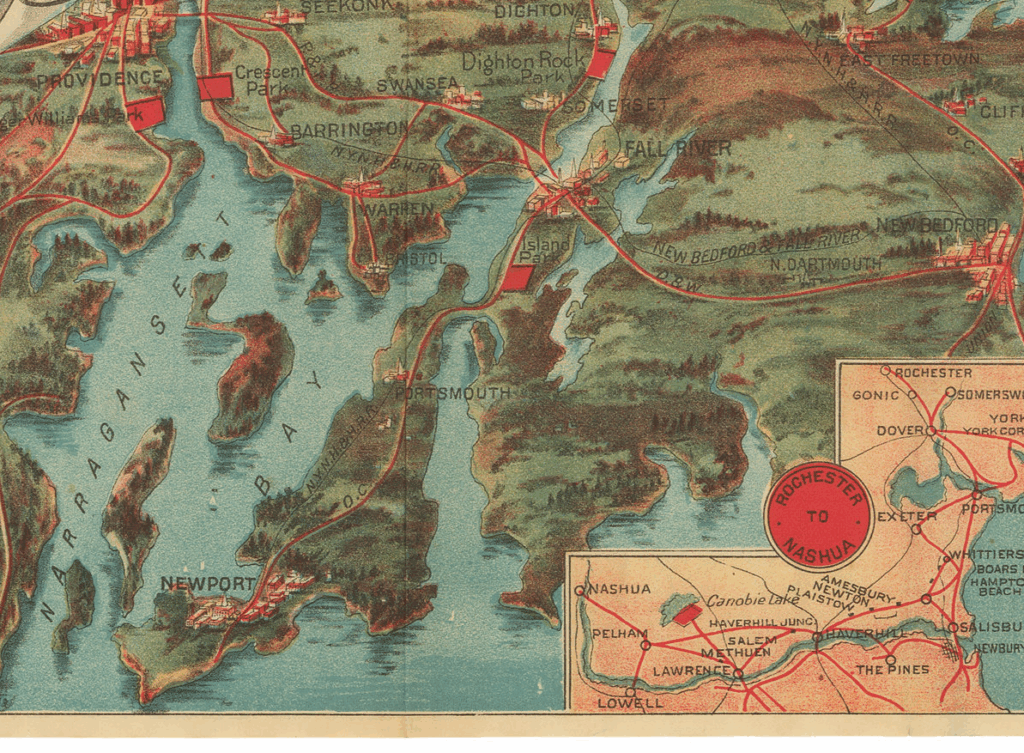
Crop of Geo. H. Walker & Co., and New England Street Railway Club. “Trolley wayfinder, birds eye view of trolley routes in New England.” Map. Boston: New England Street Railway Club, 1904–1905. Norman B. Leventhal Map & Education Center, https://collections.leventhalmap.org/search/commonwealth:jh343z12j (accessed December 24, 2025).
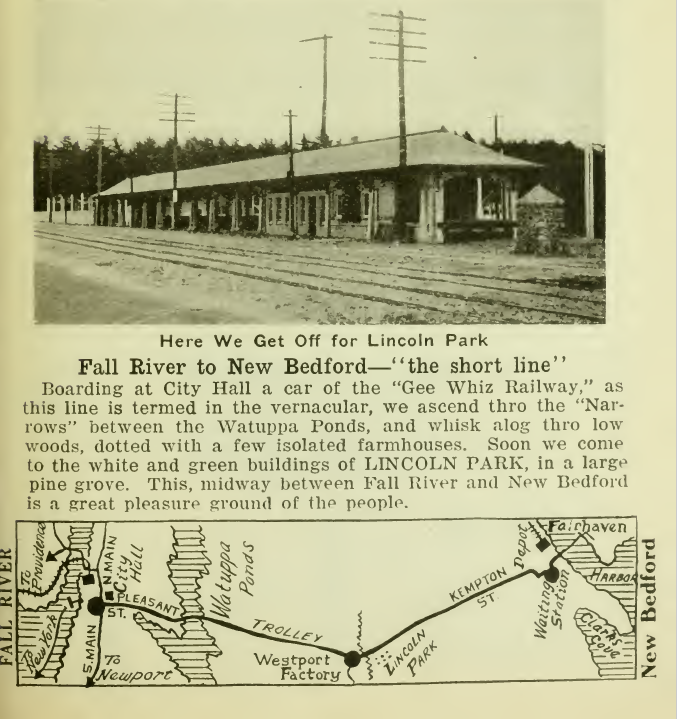
A well-known section of the street railway system connected New Bedford to Fall River via the Dartmouth and Westport Street Railway, a joint project by the Union Street Railway of New Bedford and the Globe Street Railway of Fall River.
(for more on Lincoln Park trolley line visit https://www.dartmouthhas.org/trolleys.html)
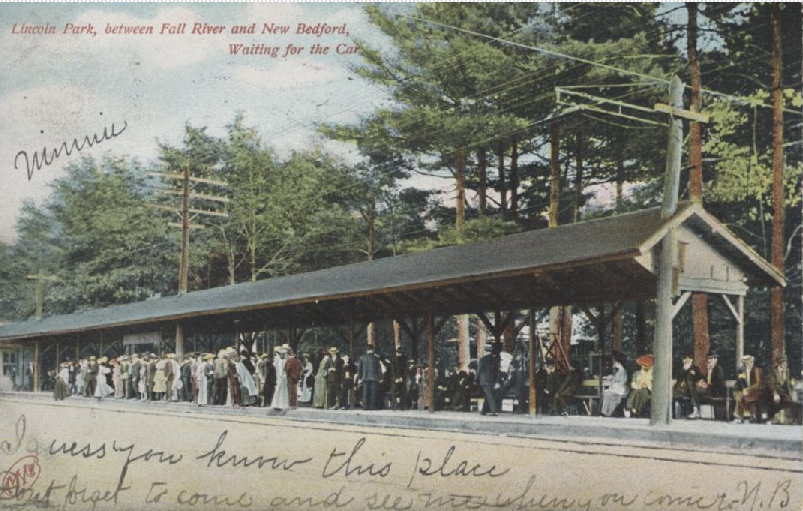
Waiting for the car at Lincoln Park
Unofficially dubbed the Gee Whiz Railway, it transported passengers along Route 6 through “the Narrows between the Watuppa Ponds … thro low woods, dotted with a few isolated farmhouses … to the white and green buildings of LINCOLN PARK, in a large pine grove. This, midway between Fall River and New Bedford is a great pleasure ground of the people.” (Trolley Trips through New England 1918)
Some street railways also proved to be highly profitable, offering enticing projects for financiers. Street railways offered opportunities beyond that of transporting passengers. Street railway companies could also transport freight, mail, and could sell electricity for lighting purposes.
By 1903, Horseneck Beach had become the focus of a “merry war … between the two opposing bands of capitalists” who formed competing corporations: The Horseneck Beach Street Railway and the South Shore Street Railway Company.
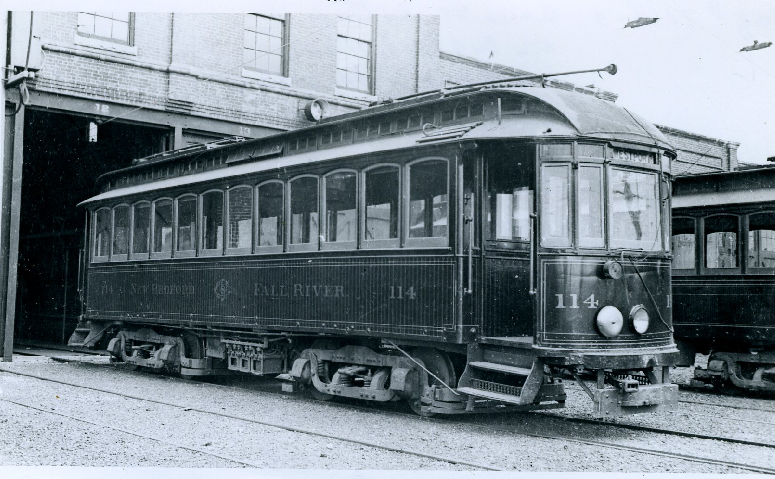
WHS 2015.043.002
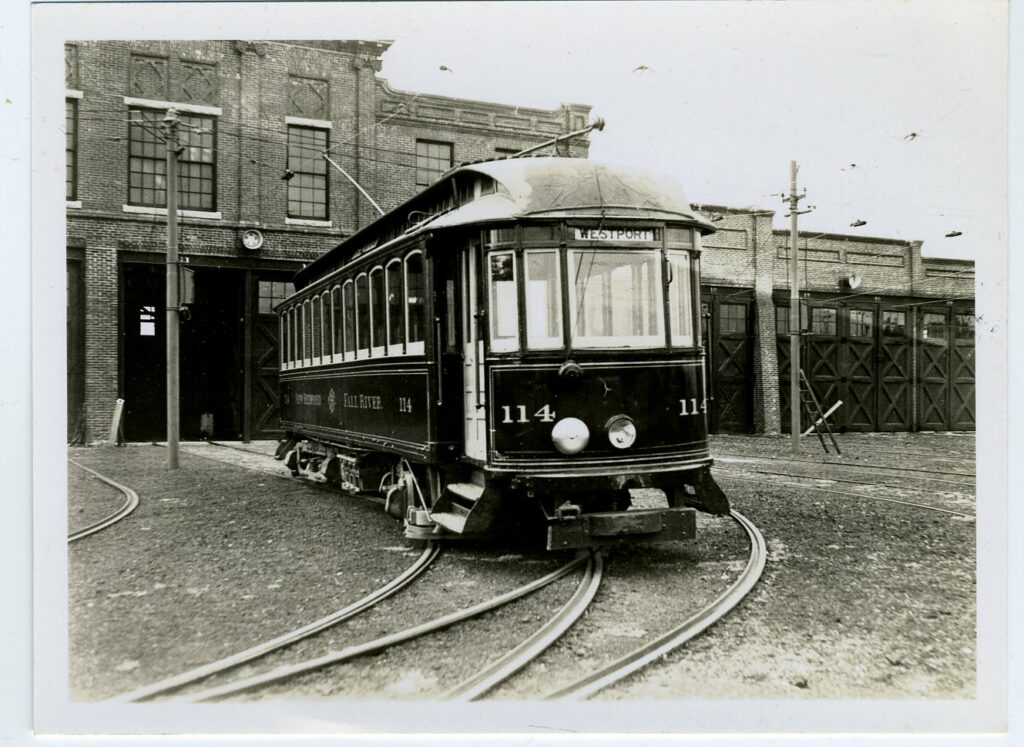
WHS 2015.043.001
South Shore Street Railway Company
Incorporated in April 1903 by Abraham Manchester, Arthur Phillips, Judson Mackenzie, Nathaniel Church, Edwin Cornell, Pardon Brownell, Godfrey Cornell, Warren Barker, George Dubois, and Nathan Everett. They proposed a route via Stafford Road to Adamsville, a distance of 8 miles (Fall River Globe, March 21 1904).
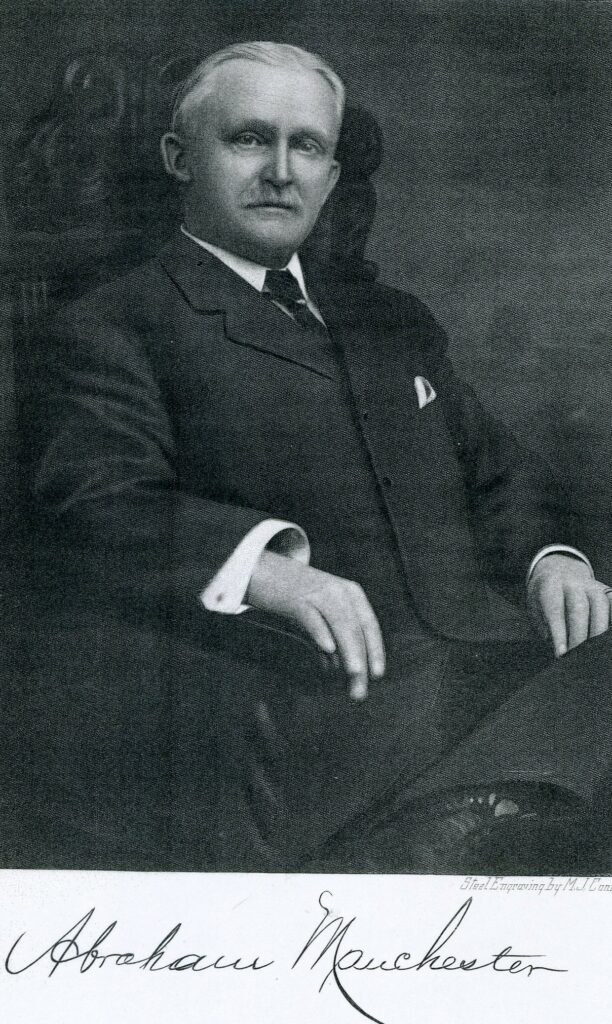
WHS 2025.058.002 Abraham Manchester
WHS 2025.058.002 Abraham Manchester
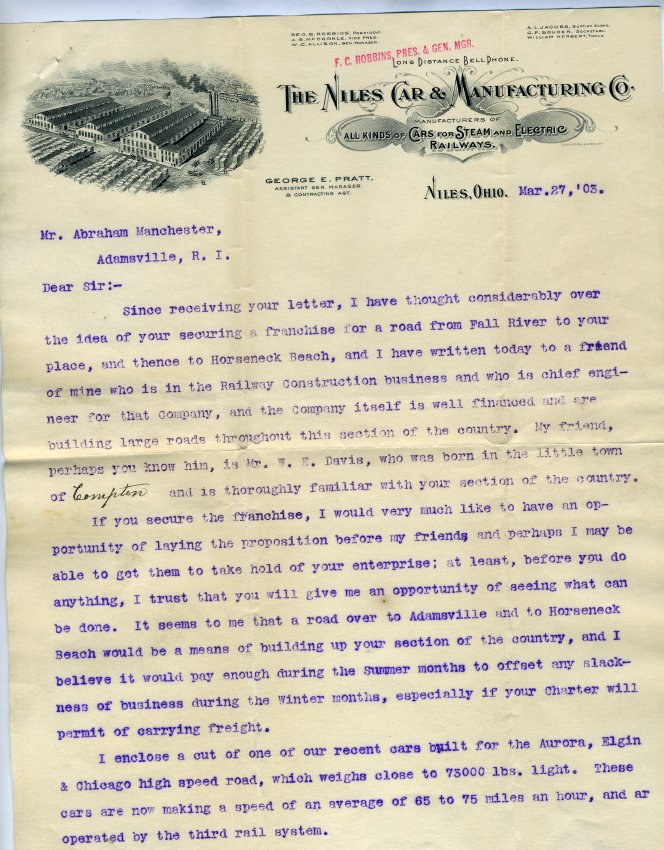
A recent donation includes a letter addressed from the Niles Car and Manufacturing Company, Ohio to Abraham Manchester of Adamsville about a proposed railway line connecting Fall River, MA to Adamsville, RI and Horseneck Beach (Westport, MA).
“Since receiving your letter, I have thought considerably over the idea of your securing a franchise for a road from Fall River to your place…”
“It seems to me that a road over to Adamsville and to Horseneck Beach would be a means of building up your section of the country, and I believe it would pay enough during the Summer months to offset any slackness of business during the Winter months, especially if your Charter will permit of carrying freight.”
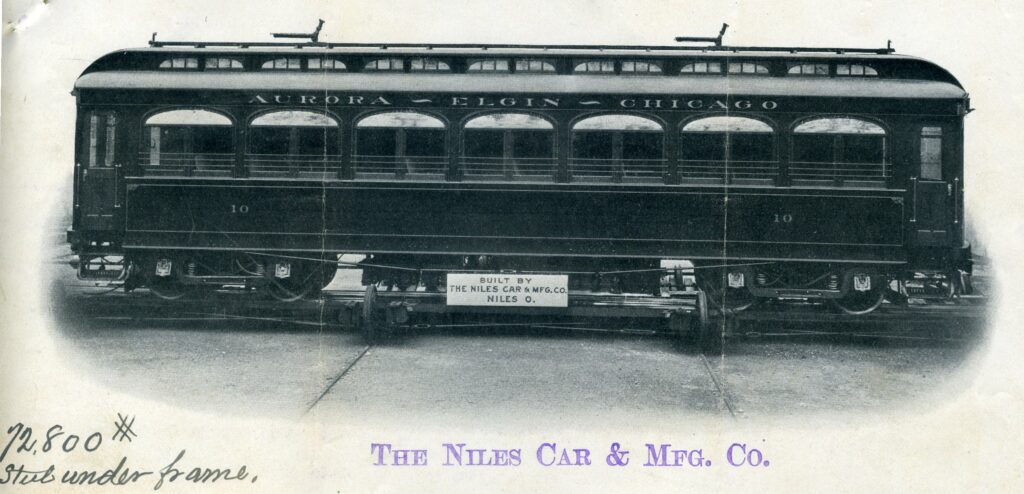
I enclose a cut of one of our recent cars built for the Aurora, Elgin & Chicago high speed road, which weighs close to 73000 lbs. light. These cars are now making a speed of an average of 65 to 75 miles an hour, and are operated by the third rail system.”
WHS 2025.058.001
WHS 2025.058.001
Horseneck Beach Railway Company
Petitioners for this project included residents of Smiths Neck and residents of Westport –John H. Gifford and C.F Gifford. A.S. Pennock, president of Ossipee Valley Street Railway, provided capital.
The proposed line would make it possible for the general public to reach “one of the finest ocean beaches on the coast.”
They planned to link Horseneck Beach to Union Street Railway Company’s line at Padanaram, proposing a route along the shore of the Apponogansett River, Gulf Road, Potomska Road to Russells Mills and on to Horseneck Beach via Beach Road, continuing across the river to Westport Point, and eventually connecting to Adamsville. Wishing to remain independent and maintain its own connection with Fall River, another company – Westport Street Railway Company – was set up to connect the line to Fall River through Sanford Road.
Appearing before the legislature in 1903, Mr. Sheldon, counsel for the petitioners, articulated their desire to carry freight and mail, and to sell electricity for lighting purposes.
Their proposal was received with suspicion by some who criticized the petitioners for requesting “unusual and sweeping power.”
“I see you want to take land by right of eminent domain,” said Representative Chace. “Isn’t that extraordinary?”
Several residents spoke in favor of the project, among them Alvin Waite who pointed out the transportation and freight needs of 160 summer cottages on Smith’s Neck.
E.G. Gifford of Westport spoke of the need for the road to carry poultry and to buy grain for his stock, the “right to carry freight was essential for his business.”
Fall River Evening Herald Feb 4, 1903
“The war for a street railway franchise in Westport to Horseneck Beach is already on in earnest and there is a promise that big forces may clash before the end comes. Many of the townspeople want a railroad from Westport Factory through Central Village and down the main road through Westport Point. But Tiverton and Adamsville people want to have a road built from the west side of the town to connect with the Old Colony system at Stone Bridge or on Stafford Road. By this move Fall River people for Horseneck beach would be fully accommodated.”
The residents of Westport Point strongly opposed the project:
“the Pointers are already disturbed at the thought of thousands of excursionists ploughing through their preserves on the Sabbath and getting over on to the wonderful beach where they have hitherto roamed alone.”
The company acquired property at Horseneck Point and in 1904 secured a license to widen its wharf at Westport Point.
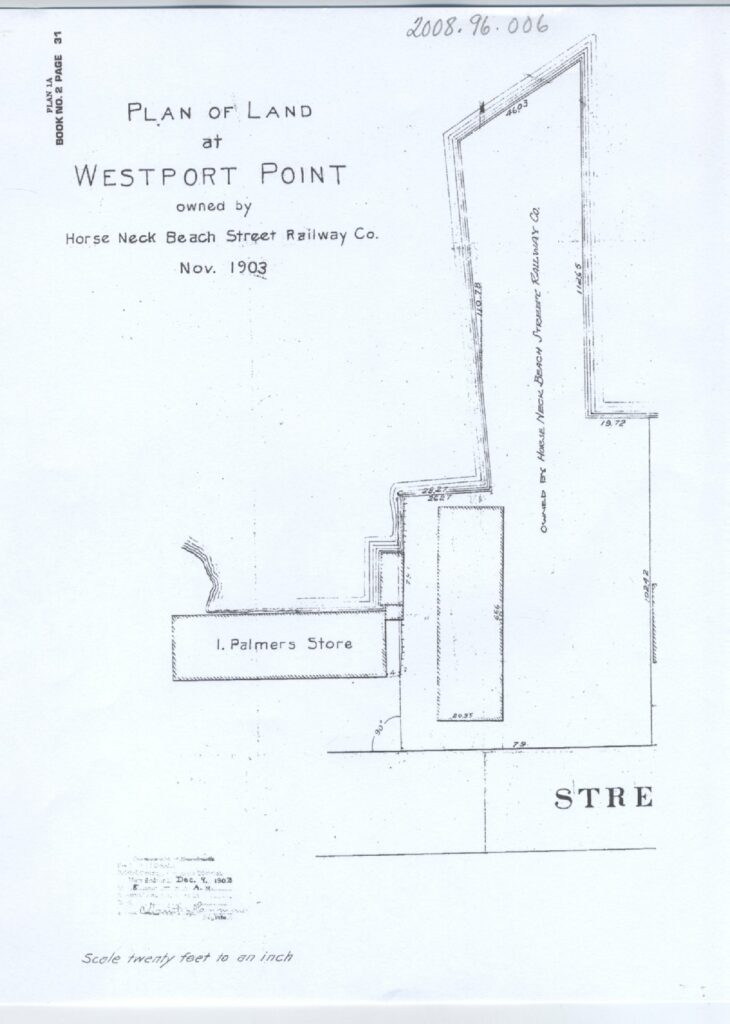
WHS 2008.096.006 Layout of land at Westport Point owned by Horseneck Beach Street Railway Company 1903
The promoters were somewhat surprised that more local people did not subscribe for stock in the enterprise. Altogether about 100 people subscribed for stock in amounts from $100 to $1000.
Challenged by the coming of the automobile, the proposed street railway did not move forward. By 1911 the property of the Horseneck Beach Street Railway Company was sold – rails and sleepers to Old Colony Street Railway, real estate known as Cory’s Wharf $510, and one wagon sold for $5.
Another attempt was made in 1907 with the formation of the Shore Line Street Railway Company involving several Westporters, among them Andrew Sowle, J.M. Shorrocks, and C.F. Macomber. They proposed an alternative route from Lincoln Park along the east side of the river to Horseneck Beach via Pine Hill Road, and then to Westport Point (Fall River Evening News 1907).
The Dartmouth-Westport Street Railway continued to operate until 1946.
The Trolleygrams 1924 WHS 2010.030.001
This publication highlights the story of a North Westporter, Fred K. Alty:
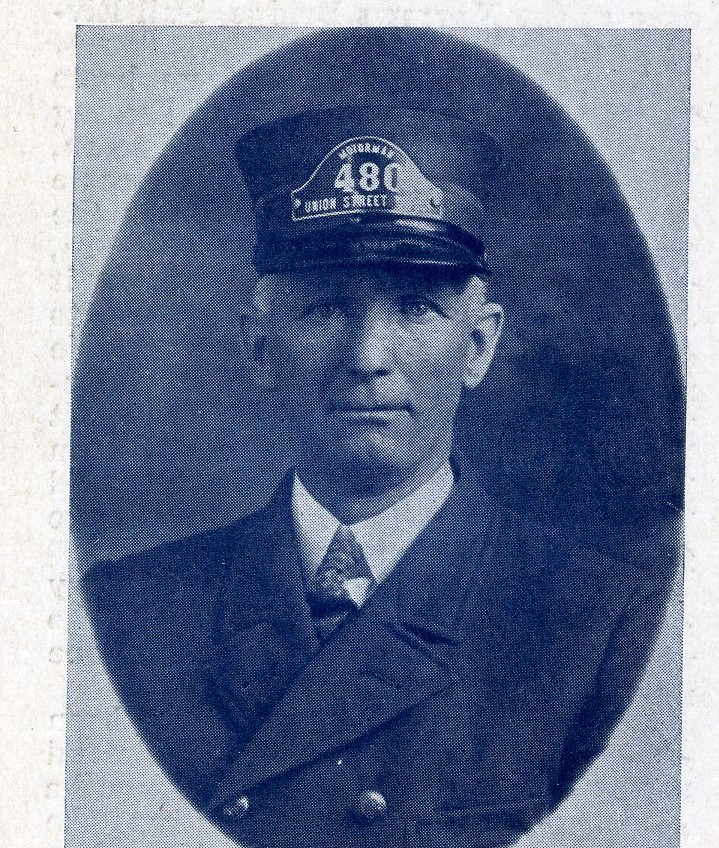
Fred Alty
Motorman Fred K. Alty whose photo appears above was born in North Westport, January 29th, 1871. When about two years of age his parents moved to Fall River. Here he received his education in the public schools.
His first work was on the farm where he worked with his father. In the year 1890 Mr. Alty left the farm and entered the employ of the Globe Street Railway Company, staying with that company until July 15th, 1894. He entered the employ of the Dartmouth and Westport Railway Company on that date. He has worked on that line continuously ever since that time.
Mr. Alty has always been interested in the employees and was in many chairs in the old Association (Union Street Railway Employees’ Relief Association) and has held several chairs including President of our present organization.
His favorite hobby is rabbit hunting and when the season is on you will find him following the trails for miles around. On the 15th day of July, Mr. Alty will have rounded out 30 years of continuous service with the Street Railway Company.
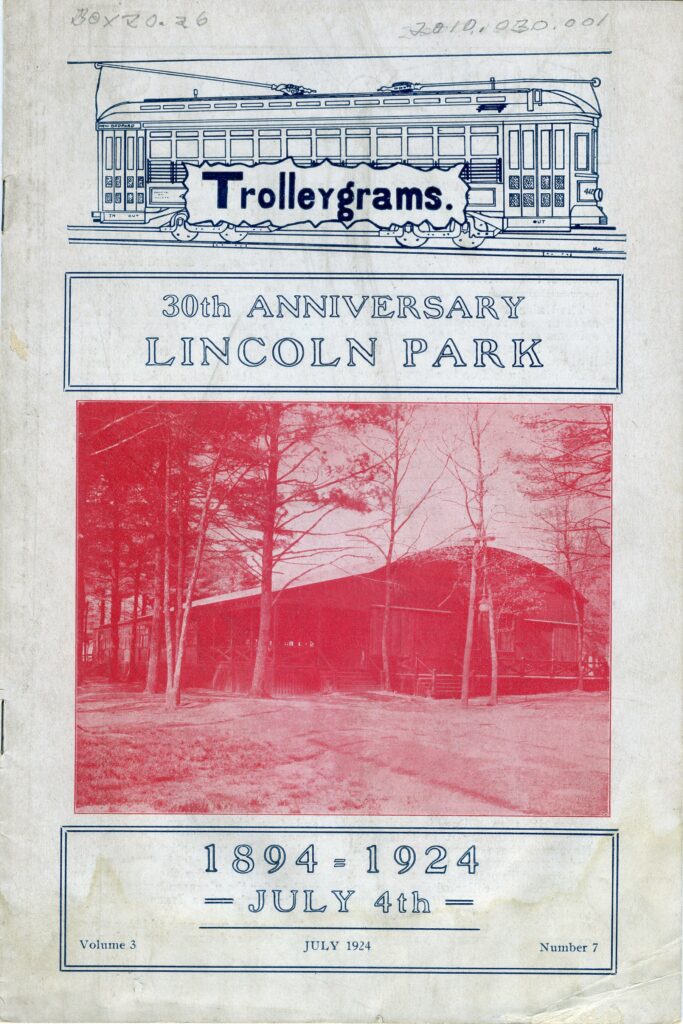
The Trolleygrams 1924 WHS 2010.030.001
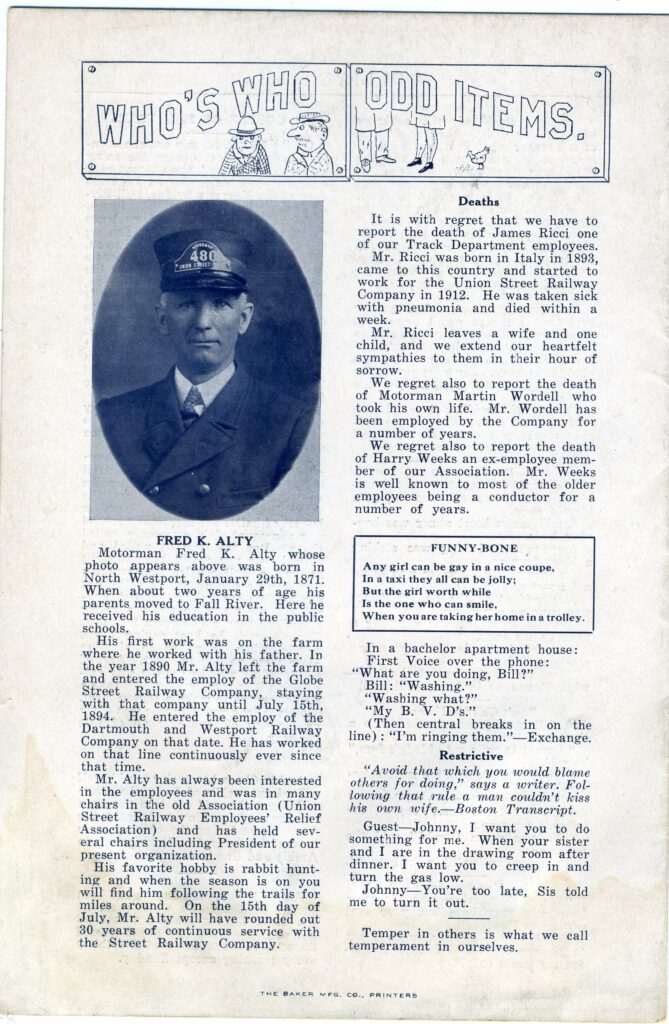
The Trolleygrams 1924 WHS 2010.030.001
WHS 2010.030.001 Trolleygrams
This transcription covers the four pages of the June 1924 edition of “Trolleygrams,” the employee magazine for the Union Street Railway Company of New Bedford, Massachusetts.
Page 1: Editorials & Trolleygrams
**EDITORIALS**
**THE EMPLOYEES’ OWN MAGAZINE**
Published every month by the Union Street Railway Employees’ Association, Inc., New Bedford, Massachusetts.
**STAFF**
* **STANLEY WELCH ROUSE:** EDITOR
* **Charles B. Bickerstaff:** Associate Editor
* **Elbridge A. Shaw:** Associate Editor
* **Harry C. Inman:** Business Manager
The Union Street Railway Company assumes no responsibility for any opinions expressed or any statements or other items appearing in this publication. Distribution is free to all employees. Communications from employees, company officers or other interested parties are solicited. Reprints—Permission to reprint any original contribution appearing herein, is granted, without reservation, providing due credit is given.
### THIRTIETH ANNIVERSARY LINCOLN PARK 1894-1924.
Thirty years ago this Fourth of July crowds of people from both New Bedford and Fall River invaded Lincoln Park on its opening day. The electric cars running between Fall River and New Bedford did a tremendous business on this opening day and a number of employees who were on duty on these cars vouch for this statement. Conductor Arthur Taber who was a conductor on one of the electrics that momentous day says:
“I remember two incidents of running on the opening day thirty years ago this Fourth of July, to Lincoln Park. One was we carried so many people from both Cities over to the Park that we were having a hard time to get them home again. Mr. Abbott P. Smith, I think it was, conceived the idea, to take a large sand car that was there, and place planks across it, then filling it with passengers and towing it to Fall River Narrows, there were seven planks and six passengers to a plank, they had to get into it with a stepladder. The Conductor collected the fares before it started. When they got over to the Narrows they had forgotten the stepladder and had a great time getting out, but were all young people and did not mind much. This flat car made only one trip. The other instance I remember was a number of Fall River carmen boarded my car at the Narrows and when I went to get their fares they did not want to pay any. But they did and Fred Alty was one of them.”
In the early nineties single rail was used from city to city with an occasional turnout through the country. The movement of cars was governed by telephone from the Weld street carstation. The cars were small single truck cars with hand brakes. This is quite a difference to the double track system and the powerful four motor double truck cars now plying between the two cities. The original park was smaller and had much fewer attractions of course than are now to be seen there yet the novelty of a nice cool ride out from either city to the quiet pines and the attractive dance hall were enticing to many thousands of people that day and they probably made the best of it. It has been said that on the opening day so many people congregated at the park that it was three o’clock next morning before all the people could be gotten away from the Park.
The Union Street Railway management or rather the Dartmouth and Westport division saw the fertile possibilities for making money from an amusement park placed so conveniently between the two cities. Their foresight was correct and the Company has reaped the fruits of the venture many times over since that opening date.
The late Isaac W. Phelps was the real man of the hour in the building of the Park and enlarging the Park proper, the Dance Hall and bringing new attractions to settle there. Mr. Phelps was active for many years after the opening in the affairs of the Park and it was through his guidance and foresight that we have such a remarkable and beautiful spot in our vicinity. He was active up to within a few months of his death and it was a great loss for the Company as well as for the pleasure loving patrons of the Park, when Isaac W. Phelps “passed on.”
Year after year new additions, new attractions and expansions took place and every new season saw a better and better looking Park. The Park grounds were made more beautiful. The walks through the Pines and around the Lake were made attractive by hedges and shrubbery. Everything was done to make the place a mecca for pleasure seeking people. A theatre was built which ran for many years. This theatre was an open air affair and was very attractive. Double rails were laid in 1906 between the two cities and large double truck cars plied across the country carrying thousands of people out to the Park. Attractions began to line up and a Roller Coaster was built. Playgrounds were enlarged. A baseball diamond was graded and bleachers or grandstand was built. Lately the Park Entrance has been remodeled and it now greets the eye of the newcomer with a becoming grandeur hard to explain. New track layouts for siding cars have added to the facilities of handling large crowds quickly and safely. Last year the Dance Hall was enlarged and now is about twice its original size. It contains refreshment booths and all modern improvements to be found in any high class dance hall. The theatre has been remodeled into an overflow dance hall and is quite well patronized.
The Park was the scene, for a number of years, of the Southern New England County Fair which was attended by many thousands of local as well as out of town patrons and attracted widespread notice for its wonderful displays and attractions.
Perhaps there are very few people who travel over to this wonderful amusement place who were there on its opening date, yet those few that were there on July Fourth, 1894 will be awed at the wonderful changes these thirty years have made. And those who see it for the first time on its 30th Anniversary will also be awed at its quiet restful atmosphere, its chance for recreation and its air of cordiality which it extends to all who visit within its portals. This is Lincoln Park of thirty years ago and the Lincoln Park of today.
It is to be hoped that the present Park management carry on the good work and always keep Lincoln Park the foremost amusement place in this locality.
In connection with the Anniversary of Lincoln Park we would like to give a little data concerning crews on the Fall River line.
### TROLLEYGRAMS (Continued)
From the opening of the Fall River road to the 15th., of July, 1894, spare men operated the cars between Fall River and New Bedford. On July 15th., of that year regular men chose runs on this line as follows:
**Cars pulling out from New Bedford;**
* **First Car:** Motorman William Vose, Conductor Jerry Taber
* **Second Car:** Motorman C. Robinson, Conductor Sam Brittain
* **Third Car:** Motorman Reuben Taber, Conductor Harry Weeks
* **Fourth Car:** Motorman J. Johnson, Conductor A. Sherman
* **Fifth Car:** Motorman William Thompson, Conductor Martin Galvin
**Cars pulling out from Fall River.**
* **First Car:** Motorman Bob Waite, Conductor F. Russell
* **Second Car:** Motorman M. Lawlor, Conductor Sam Davis
* **Third Car:** Motorman R. Chase, Conductor Harry Perkins
* **Fourth Car:** Motorman F. Rinfret, Conductor F. Morrisey
* **Fifth Car:** Motorman Fred Alty, Conductor Ed. Moulton
Only three of the above are still with us; Fred Alty and Bob Waite and Sam Brittain.
Thinking without acting is about as bad as acting without thinking.
Hate yourself and the other fellow will follow suit.—Hinze.
Give the best you have and the best will come back to you.
Accidents are a waste.
Don’t merely think it over—put it over.
Of all the excuses there are
By which this old world is accursed,
This “haven’t got time” is by far
The poorest, the feeblest, the worst,
A delusion it is, and a snare;
If the habit is yours, you should shake it,
For if you want to do what is offered to you
You’ll find time to do it, or make it.
—Detroit Free Press.
—
## Page 2: Mr. Wilde’s Travels and Gift
**TROLLEYGRAMS**
*Mr. Wilde receives gift of appreciation from Employees.*
Thursday June 12th., will always be a recollection pleasing to Mr. Elton S. Wilde our Vice President and General Manager for the very good reason that upon that date he received from his employees a handsome gold watch, chain and cigar cutter as a token of appreciation.
The event was staged at the Weld street Car Station and was a complete surprise to Mr. Wilde.
An invitation was extended to him to give a talk on his experiences on his recent trip across the Atlantic and of the countries and cities he had visited. One talk was given in the morning to the night and spare crews, preceded by a safety talk given by Mr. Whiting of the Liberty Mutual Insurance Company which was illustrated by moving pictures. A good attendance was had at this morning session.
The evening session which was the big affair opened at 8.30 after the regular meeting of the Union Street Railway Employees’ Association was adjourned. A packed house awaited eagerly the program of the evening. The Fort Phoenix Orchestra having tuned up started livening up the affair until Mr. Wilde and Invited guests arrived.
Then Mr. Wilde accompanied by Mr. Sweeney with whom he traveled abroad, and officers of the Company; Mr. Crapo, Mr. Rexford, Mr. Nicholson, Mr. Pierce, Mr. Fuller, Mr. Dole and members of the Board of Directors entered the Hall amid a thunderous applause. Everyone united with the Orchestra in singing “Hail, Hail the gang’s all here.”
Mr. Rexford acting as chairman of the event gave a short talk on accident prevention. Mr. Whiting of the Liberty Mutual Insurance Company gave an illustrated talk on accidents which was very interesting as well as helpful.
Then Mr. Rexford introduced Mr. Wilde and the audience was held attentively for some time by Mr. Wilde’s story of his trip across the Atlantic. Some of the vital points of his speech are recorded here:—London is a city of busses and an impression one gets upon arrival in London is that of a circus parade with its gayly decorated (by advertisements) busses.—Busses are usually double deckers, the entrance being at the rear. They are limited to the number of passengers to be carried, each bus bearing a sign of the number entitled to ride and this regulation is strictly lived up to. —There are signs along the route which read “BUSSES STOP UPON REQUEST”—”BOOK BY THE TUNNEL,” whereas we would say “TRAVEL BY THE TUNNEL.” The ticket offices etc., are labeled “BOOKING OFFICES.” “GOODS STATION” in place of “FREIGHT STATION.” Another sign placed on all cars and busses is “PASSENGERS LEAVING CAR IN MOTION DO SO AT THEIR OWN RISK.”—The tram or trolley cars operate along the Thames and on the outskirts of London. These cars are of the double deck type. Quite a few of the cars are of the same dimensions as our No. 10 horse car—The London car has only four windows. Hand brakes are used throughout Great Britain.
—In Manchester they operate double deck cars and on a great many cars a boy is employed to tend trolley and guard platform.—From Manchester the Manager of the street railway published a formula as to the proper merits of the tramcar:
(1) Motor busses are best and most economical for any service not requiring greater frequency than four vehicles a day.
(2) Trackless trolley for service for from four to six vehicles a day.
(3) Tramcar or trolley undoubtedly the most generally satisfactory vehicle for six or more cars per day.
—Upon our entrance to Glasgow we observed a lady conductor and later upon the line running to Hamilton we observed cars being operated by a lady motorman and a lady conductor. —Here (in Newcastle) we found tramways of every type imaginable, some in good shape but many in a dilapidated condition.—The cars in Paris are operated singularly and in two car trains. No upper deck cars are used. The long trolley poles attract one’s attention. The Conductor of the second car signals the crew of the first car by blowing a whistle which sounds like a squealing balloon whistle.—They operate first and second class passenger cars, the cars carrying a plate alongside which indicates whether it is first or second class. Cars carry route numbers. Gongs on the cars are very noisy and sound like those of our fire department. Guards think nothing of smoking on duty. Lady conductors are…
—
## Page 3: Presentation and Stories
**TROLLEYGRAMS (Continued)**
…quite common. No double deck cars except in the outskirts of Paris. Cars are operated by an underground trolley in the centre of Paris there being no overhead trolley wire.—
At the conclusion of Mr. Wilde’s very interesting account of his experiences in the principal Cities of England and France, Mr. Crapo arose and made the following remarks:
While I think Mr. Wilde has given a pretty good account of himself, of course there are a few things we would like to know. He hasn’t told us how many shillings and francs it costs to get a nickle ride over there, but I imagine he knows about it.
He has explained about the sign COMPLETE which means that the car is full and they won’t take any more passengers. We would like to know how that rule works when it is the passenger and not the car that is full.
I have been asked by all of the girls and boys connected with work of the Union and Onset Street Railways if you thought that he had really given a good account of himself to bring in a verdict. I have been given a sealed verdict: I don’t just know what is in the verdict, but if you think he has given a good account of himself I will open the verdict, provided you say so.
(There was an enthusiastic AYE from everyone.)
“Perhaps it would be better to present the indictment of the complete grand jury and it is complete as written. It is evidently in anticipation of the verdict;—
> **A token of appreciation To Mr. Elton S. Wilde**
> **From the employees of the Union Street Railway and New Bedford and Onset Street Railway Companies.**
> We, the employees of the Union Street Railway Company and New Bedford and Onset Street Railway Company extend to you, Mr. Wilde, our gratitude for your safe return from your overseas journey. We hope that your recent trip has been very enjoyable.
> We feel confident that you are glad to be with us again and to once more resume the helm. And let us also wish you good luck in your future at that helm.
> We are sure that your years of service with the Union Street Railway Company and side by side with us, the employees, is a very strong recommendation of your high standard of fair dealing.
> It is with a feeling of satisfaction and also gratitude, that we review the many projects especially those which have dealt with the employees, their working conditions and the settlement of our few labor disputes, that you have so satisfactorily settled to better our conditions and keep us as a body, content and willing to do our best.
> The help that you extended to our employees association and your constant co-operation along this line is to be highly commended. In our numerous conferences, upon which you were asked to attend, you have always been courteous and willing to meet us on equal footing and to help us whenever an opportunity afforded itself to you. Your gift to us of the employees’ own magazine “Trolleygrams” which is edited by and for the employees, is also a recommendation of your thoughtfulness.
> Mere words can but faintly express our gratitude for these and many unmentioned concessions you have secured for us. Suffice to say we are very glad to have a man with the courage and convictions to stand up for his men, at our head.
> Your indulgence in outside affairs, such as politics, social and economic organizations and your whole hearted co-operation in all the higher projects in which all the citizens of our city are helped, is a profound proof of your enthusiastic willingness to be of service when opportunity beckons.
> Now, we, the employees, some with long years of service behind us, and still others with only a few short months to our credit unite in extending to you, Mr. Wilde, the best wishes of the day, for your past success and may God grant that you may continue to lead us on indefinitely ever towards success and ever towards the goal of perfection.
> We hope you will accept this very simple and perhaps too brief token of our appreciation to you as our General Manager, for your friendship and help in the years now only memories and your spirit of resolution which permeates us all and binds us as one in “Carrying On.”
> May you always prosper and succeed. This is our simple wish. May God grant it.
> **To Mr. Elton S. Wilde, June 1924.**
> **Signed, For the Employees, Stanley W. Rouse.**
Mr. Crapo continued: “I do not know whether this is a Cadillac or a Buick or a Ford or what it is, but I understand it is guaranteed to keep on Standard time anyway. On behalf of the employees I wish to present it to Mr. Wilde. It is inscribed ‘ELTON S. WILDE. In appreciation from the Union and Onset Employees—1924.'”
Mr. Crapo then presented the watch, chain and cigar cutter pictured on the preceding page to Mr. Wilde.
Mr. Wilde arose amid great cheering and addressed the assembly;
“Ladies and Gentlemen;
You certainly have taken me by surprise. I assure you I appreciate this thoughtfulness. I know that you are sincere in welcoming me back, and I am sincere when I say that I am glad to get back. For your generosity and thoughtfulness I thank you one and all.”
*Through this medium the employees wish to thank the members of the committee who put over this time and made it such a grand success.*
**Back in 1890**
* The world’s most famous automobile manufacturer was working in a bicycle shop.
* A millionaire hotel owner was hopping bells.
* America’s steel king was stoking a blast furnace.
* An international banker was firing a locomotive.
* A President of the United States was running a printing press.
* A great merchant was carrying a pack on his back.
* A railroad president was pounding a telegraph key.
* There’s always room at the top—where’ll you be in 1954?—Ad-points.
**Don’t Call Me Names!**
A tall strong man walked into a shop.
“I want to get a set of lady’s furs,” he said.
“What kind?” asked the male salesman.
“That brown set in the window will do if it’s not too dear,” replied the tall, strong man.
“Oh, you mean skunk?” said the salesman.
The salesman is still in the hospital.
**Non-Support**
“Yes, Bobby, when you die your body will stay here but your soul will go to Heaven.”
“Well, then, mother, when I get to Heaven what will I have to button my pants onto?”
**A COUPLE OF FISH TALES**
On the 5.20 P. M. trip out one evening, early in May, during the rainy season, Bill Almond, the diligent rear end pilot, lost his trolley on the cross over at the Narrows Bridge, Fall River line.
Bill, clothed in rubber from boots to helmet, made such a job of freeing the rope, that his stalwart motorman, Bill Beauregard, left his post to come to his assistance, when just then the trolley rope caught the red lantern, unbeknownst to him and pulled it down on his head, causing him to drop in his tracks for a moment. He recovered quickly and looked at Beauregard, wondering whether he had hit him with the controller handle. When Beauregard produced the crumpled lantern all was well. They still go feeding the fishes together.
Of Beauregard, Reynolds, Gregory and Almond, this story is told, who went fishing, bright and early one morning brave and bold.
But alas—the fish must have been all asleep—for although Bill Almond baited his hooks a thousand times he only succeeded in tangling up the other lines. After he had used a bushel of bait Poor Bill finally landed a no account fish commonly called skate. But the way he pulled and turned pale you would have thought he had a bull whale. Beauregard’s line began abobbing and he pulled out a worthless sea robbin. About Reynolds I must say he made a better Chauffeur than a fisherman that day. For although he kept saying I got a bite, when he pulled in his line there were no fish in sight. And of Gregory??? well he got the only eatable fish it is true, but it would take a bushel or two to make a square meal.
This is by a reporter who was down on his day off and saw all of this Tragedy.
Archie Chase has took unto himself a Ford automobile of doubtful vintage and begets himself out into the open country each evening to breathe the fresh air and view the country same as the rich bugs do. More power to Archie and Gas too.
A free information bureau has been opened in the men’s wash room at the Weld St. car station, where all the politics of the day are discussed fluently, between five and five-thirty every morning except Sunday.
—
## Page 4: Who’s Who & Odd Items
**WHO’S WHO / ODD ITEMS**
### FRED K. ALTY
Motorman Fred K. Alty whose photo appears above was born in North Westport, January 29th, 1871. When about two years of age his parents moved to Fall River. Here he received his education in the public schools.
His first work was on the farm where he worked with his father. In the year 1890 Mr. Alty left the farm and entered the employ of the Globe Street Railway Company, staying with that company until July 15th, 1894. He entered the employ of the Dartmouth and Westport Railway Company on that date. He has worked on that line continuously ever since that time.
Mr. Alty has always been interested in the employees and was in many chairs in the old Association (Union Street Railway Employees’ Relief Association) and has held several chairs including President of our present organization.
His favorite hobby is rabbit hunting and when the season is on you will find him following the trails for miles around. On the 15th day of July, Mr. Alty will have rounded out 30 years of continuous service with the Street Railway Company.
### Deaths
It is with regret that we have to report the death of **James Ricci** one of our Track Department employees. Mr. Ricci was born in Italy in 1893, came to this country and started to work for the Union Street Railway Company in 1912. He was taken sick with pneumonia and died within a week. Mr. Ricci leaves a wife and one child, and we extend our heartfelt sympathies to them in their hour of sorrow.
We regret also to report the death of **Motorman Martin Wordell** who took his own life. Mr. Wordell has been employed by the Company for a number of years.
We regret also to report the death of **Harry Weeks** an ex-employee member of our Association. Mr. Weeks is well known to most of the older employees being a conductor for a number of years.
### FUNNY-BONE
* Any girl can be gay in a nice coupe,
* In a taxi they all can be jolly;
* But the girl worth while
* Is the one who can smile,
* When you are taking her home in a trolley.
In a bachelor apartment house:
First Voice over the phone: “What are you doing, Bill?”
Bill: “Washing.”
“Washing what?”
“My B. V. D’s.”
(Then central breaks in on the line): “I’m ringing them.”—Exchange.
**Restrictive**
“Avoid that which you would blame others for doing,” says a writer. Following that rule a man couldn’t kiss his own wife.—Boston Transcript.
Guest—Johnny, I want you to do something for me. When your sister and I are in the drawing room after dinner. I want you to creep in and turn the gas low.
Johnny—You’re too late, Sis told me to turn it out.
Temper in others is what we call temperament in ourselves.
—
**THE BAKER MFG. CO., PRINTERS**
Hand-written ledger from the Union Street Railway Co. for Tuesday, April 27th, 1897 listing employees.
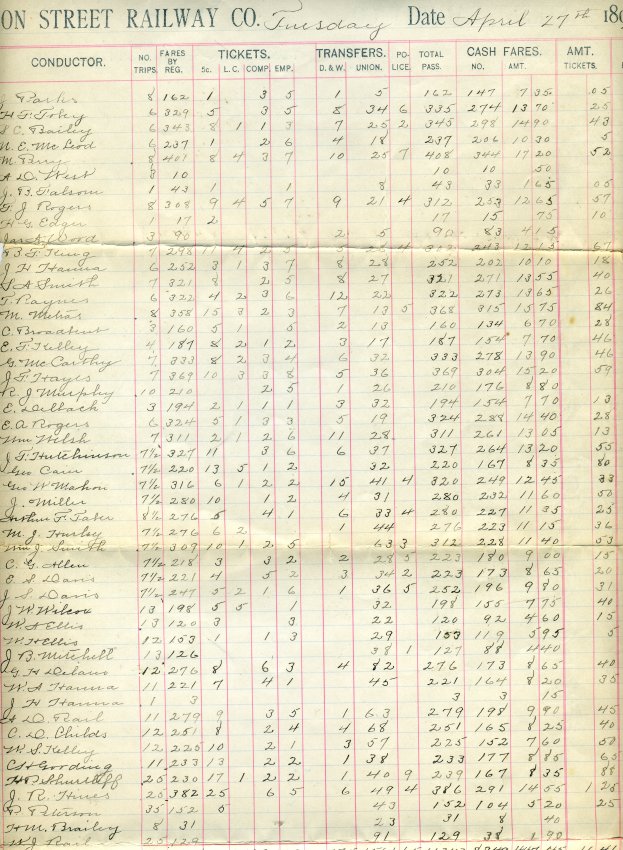
WHS 2003.25.002 Hand-written ledger from the Union Street Railway Co. for Tuesday, April 27th, 1897 listing employees.
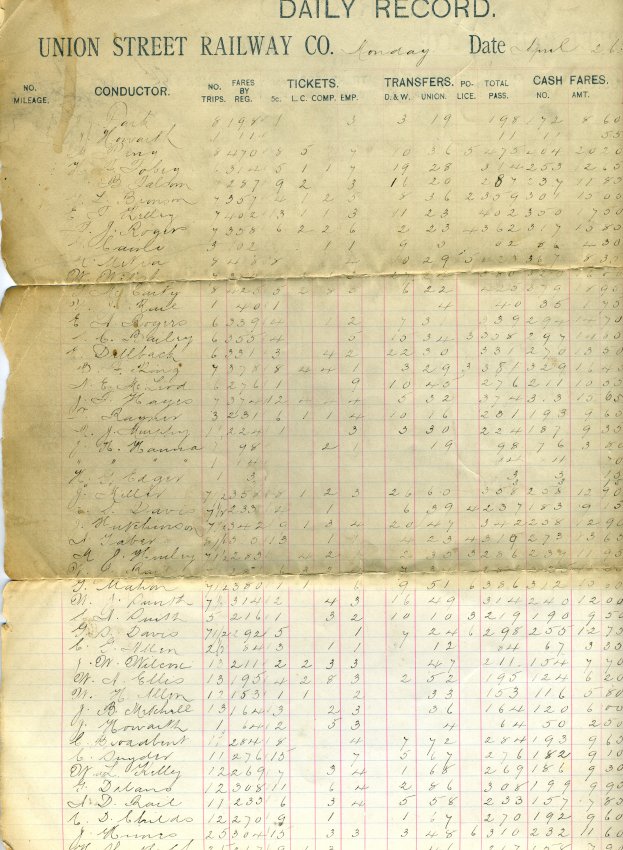
WHS 2003.25.002 Hand-written ledger from the Union Street Railway Co. for Tuesday, April 27th, 1897 listing employees.
This is a transcription of the hand-written ledger from the Union Street Railway Co. for Tuesday, April 27th, 1897. Transcribed using AI gemini. The document tracks the performance of various conductors, including trip counts, ticket types (5c, L.C., Comp, Emp), transfers, and cash fares. Ledger Summary: Tuesday, April 27, 1897
Conductor, No. Trips, Fares by Reg.,Total Pass.,Cash Fares (No.),Cash Fares (Amt.)
- Parks,8,162,162,147,7.35
- F. Tobey,6,329,335,274,13.70
- C. Bailey,6,343,345,298,14.90
- E. McLeod,6,237,237,206,10.30
- Fury,8,401,408,344,17.20
- D. West,8,10,10,10,.50
- B. Folsom,1,43,43,33,1.65
- J. Rogers,8,308,312,253,12.65
- S. Edgar,1,17,17,15,.75
Jas. H. Lord,3,90,90,83,4.15
- F. King,7,298,312,243,12.15
- H. Hanna,6,252,252,202,10.10
- A. Smith,7,321,321,271,13.55
- Raynes,6,322,322,273,13.65
- Mehan,8,358,368,315,15.75
- Broadbent,3,160,160,134,6.70
- F. Kelley,4,187,187,154,7.70
- McCarthy,7,333,333,278,13.90
- F. Hayes,7,369,369,304,15.20
- J. Murphy,10,210,210,176,8.80
- Delback,3,194,194,154,7.70
- A. Rogers,6,324,324,288,14.40
Wm. Welsh,7,311,311,261,13.05
- T. Hutchinson,7 ½,327,327,264,13.20
Geo. Cain,7 ½,220,220,167,8.35
Geo. W. Mahon,7 ½,316,320,249,12.45
- Miller,7 ½,280,280,232,11.60
Joshua F. Taber,8 ½,276,280,227,11.35
- J. Hurley,7 ½,276,276,223,11.15
Wm. J. Smith,7 ½,309,312,228,11.40
- G. Allen,7 ½,218,223,180,9.00
- S. Davis,7 ½,221,223,173,8.65
- S. Davis,7 ½,247,252,196,9.80
- W. Wilcox,13,198,198,155,7.75
- A. Ellis,13,120,120,92,4.60
- H. Ellis,12,153,153,119,5.95
- B. Mitchell,13,126,127,88,4.40
- H. Delano,12,276,276,173,8.65
- A. Hanna,11,221,221,164,8.20
- H. Hanna,1,3,3,3,.15
- L. Pearl,11,279,279,198,9.90
- L. Childs,12,251,251,165,8.25
- S. Kelley,12,225,225,152,7.60
- S. Gording,11,233,233,177,8.85
- P. Shurtleff,20,230,239,167,8.35
- R. Hines,20,382,386,291,14.55
- P. Person,35,152,152,104,5.20
- M. Brailey,8,31,31,8,.40
- J. Pearl,2.5,129,129,38,1.90
Page 2
This is a full transcription of the names listed in the **Conductor** column, moving from the top of the ledger to the bottom.
Transcribed using AI Gemini 3
Section 1 (Top)
- **Dark**
- **J. Howarth**
- **King**
- **S. Tobey**
- **B. Talon**
- **L. Bronson**
- **J. Kelley**
- **J. J. Rogers**
- **Carle**
- **H. Silva**
- **W. Welch**
### Section 2 (Middle)
- **McCarty**
- **J. Rail**
- **A. Rogers**
- **C. Bailey**
- **E. Dillback**
- **B. F. King**
- **J. E. Leonard**
- **T. Hayes**
- **Rawker**
- **J. J. Murphy**
- **J. H. Hanna**
- [Illegible/Blank Row]
- **G. G. Eager**
- **J. Miller**
- **L. Davis**
- **Hutchinson**
- **S. Taber**
- **M. J. Hanley**
- **J. Rail**
### Section 3 (Bottom)
- **G. Mahon**
- **W. J. Pauth**
- **L. A. Smith*
- **G. S. Davis**
- **C. J. Allen**
- **J. W. Wilson**
- **W. A. Ellis**
- **W. H. Lyon**
- **J. B. Mitchell**
- **J. Howarth** (Likely a second shift or separate entry)
- **C. Broadbent**
- **C. Snyder**
- **Wm. Kelley**
- **J. Delano**
- **A. D. Rail**
- **C. G. Childs**
- **J. Munro**
- **J. H. Flint**