
Alice Huff interviewed by Jenny O’Neill
Posted on August 21, 2026 by Jenny ONeill
Alice Collins Huff, interviewed by Jenny O’Neill, August 20, 2026
Topics include:
The Head of Westport, school, July 4 parade and fireworks, Pine Hill Road
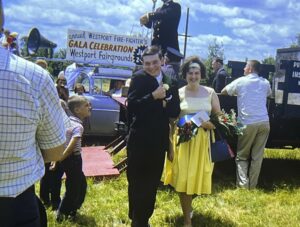
Alice Huff July 4 1963
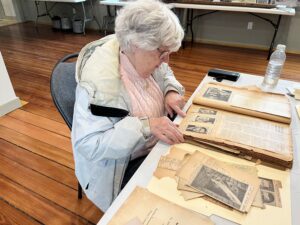
Alice Huff, 2025
Transcript of Recording
- Jenny O’Neill: I am Jenny O’Neill. It is August 20th, 2026, and I’m here with Alice Huff. So Alice, let’s start with some information about your family and the genealogy with your—if you could just give a summary of your parents and grandparents, and just get a sense of who they were.
- Alice Huff: Okay. My mother was Hazel Collins Devoll, and she was the only child of Peleg and Abby Sanford Collins. And I know a lot about my grandfather’s family. It goes back through the Lawton family, because at the Maple Grove Cemetery, I’ve found it at least back to the early—middle 1700s.
- Alice Huff: And there were Lawtons, Adams…. So it goes back right in that cemetery, you can trace them back through there. I would like to go—I have gone a little bit deeper, but not too much. My—my father was William Coffey, C-O-F-F-E-Y, and from what little I know about him, he came from Pawtucket, and owned a print shop there. And his mother was—what was her name?—Olympe Taupier, T-A-U-P-I-E-R. And I’ve tried to trace that back, and I’ve gone back to French Canadian, Canada in the 1600s.
- Jenny O’Neill: That’s an interesting mix, then, of people. So whereabouts in Westport did they live?
- Alice Huff: Okay. My great-grandmother was married to Robert Collins, who was a first mate on whaling ships. And she—they lived on Pine Hill Road, near the top of Pine Hill Road, which would be now near what is 52 Pine Hill Road.
- Jenny O’Neill: Does that house still exist?
- Alice Huff: It’s crumbling down. It’s lost its—and I… Robert Collins died at sea, and she married John Waite, I think it was John. And his father was a carpenter here in the area, and I don’t remember his name, but there’s three or four houses in Westport that have that special triangle front peak. And the old parsonage on Gidley Road has it, and I think that the son and he built that house for his—for Mary. So it’s been there at least that long. And then she goes back to the Lawton family further down Pine Hill Road across from what would have been—well, it was Ruth Edwards’ place where she grew up. Ruth Edwards was the artist, and that house was originally built in 1804 or 1808 for his bride, for Richard Lawton’s bride. And they must have owned extensive properties, because up closer to the head, there was a place even called Lawton’s Cove where my mother kept her little rowboat. And that’s where my grandfather would go out when he went, you know, eeling and fishing and all those kinds of things.
- Jenny O’Neill: Now, is there a blacksmith in the family? Who was he?
- Alice Huff: All right. Peleg, my grandfather, he died in 1943, I was born in 1945. But I feel like I grew up with him because my mother just worshipped him. And he was a blacksmith. He had a shop right there at Pine Hill Road. It was still standing when I was growing up, but it deteriorated, and they finally just left—there might still be a cement foundation there of the driveway, a little bit. He was a blacksmith… He—you know, I think there were other blacksmiths at the head, too. So it was—and he died just about the time the whole blacksmith era ended. It was interesting.
- Jenny O’Neill: And so you, tell me a little bit about your early childhood, and did you grow up at 52 Pine Hill?
- Alice Huff: I grew up at Pine Hill Road, on Pine Hill Road in that house, that was shared by my grandmother and her sister and her husband. So we had—it was like a duplex. And it was—I was an only child, there were no other children around. I lived outdoors playing, and playing in the brook. I lived—I lived in the brook!
- Jenny O’Neill: In the brook? What do you mean?
- Alice Huff: There was a—behind the house, when my mother grew up, there was a pond they could go skating on. But by the time I grew up, the evolution of a pond becoming smaller and smaller, the 100-year thing, there was just a what we called a brook that ran through it. And I would spend my—my warm—anything—any warm day, I was there, quote, “up in the woods.” And we could go way up in the woods and go blueberrying. I was just talking to my friend last night, she said she—she asked me, we were talking about Paul Cuffe—there was a path that went up the Pine Hill Road behind the house, and it hooked up with another path just on Old County Road. I can’t explain where except by telling people you wouldn’t know who lived there. But it was interesting, because and there was an area they must have cleared years before, because it was blueberries and huckleberries, and we went huckleberrying in the summertime up there.
- Jenny O’Neill: Huckleberrying? So what did you do with the blueberries and huckleberries?
- Alice Huff: Well, the huckle—it was actually—it was all huckleberries. Very few blueberries. The huckleberries, we made—my grandmother made something called—she called it slump. And you’d cook them down, and you took this glob of something that looked like, you know, a Bisquick thing, and boiled the whole thing. And it just—we had that, that was a big treat. And I had—there was a dog that went with us. He was so cool! He would go with us, and he would plop down next to a bush that we were doing, and he would just eat the berries right off the bush.
- Jenny O’Neill: That sounds like an ideal childhood.
- Alice Huff: It was—it was a—I think every day I am so thankful that I had the childhood I had. It was very lonely—not lonely, but singular. And I really didn’t realize I was an only child until I was in my 20s and—well, I did realize it, but that I didn’t have any family around me, no siblings like most people did. So it was a very… I learned to read and just devoured every book that I could possibly—you know, the children’s books, and the Nancy Drews, and the Bobsey Twins, and all of those. You just read those. And my mother would go to the New Bedford Library because she worked in New Bedford as a secretary, and she would bring home books from the library, too, for me. So it was—it created what I am. It did, it just…
- Jenny O’Neill: What did you do in the wintertime? Reading books?
- Alice Huff: A lot of reading. I think we got a telephone when I was about… I must have started school already. And it was the kind where you picked up the phone and told the operator the number. And it was a four-party line, there were different rings for everybody in that connection. So that was kind of interesting. You kind of knew what the neighbors were doing! Where was I going with that?
- Jenny O’Neill: We were talking about what you did in the wintertime.
- Alice Huff: Oh, in the winter. I guess outside, played in the winter outside as much as we could, or I could. And in the snow, the long driveway would fill up. There were two walls next to my grandfather’s blacksmith shop that went up to the house, which was in from the road a bit. It would drift full of snow, just the way it was, so it would be stone-wall high. And we would spend a day—the two families that lived there—would spend a day shoveling it. Always, when I was done, and my mother was done, my grandmother had a wonderful kettle of homemade popcorn balls. She made her own syrup and put it together. That was the treat. What else? I loved to draw. When I wasn’t reading, I was drawing or doing puzzles. I learned as an only child to just entertain myself, and I still do.
- Jenny O’Neill: What was the neighborhood like? Did you have neighbors?
- Alice Huff: Yes. Across the street was the big—it’s now Yankee Bill. That came into that family when I was about 10 years old, I think. Before that, it was owned by the Albert family, whether they owned it or they leased it out and used it, you know, had people living there. And there was another family that lived there. Down the road, there weren’t—of course, the head, I could go to the head when I wanted to. Down the road was Steve Tripp, the Tripp family. And that was basically the only other playmates I had, and I spent many, many a summer with Pat and Arnold Stevens. He has a sister, Rebecca, and we used to play. We’d play cards, that’s another thing we did was play cards. Who else was there? The Lamontagnes lived just south of us on the same side of the road. They’ve both passed, I think, yes. And then Wilfrid Sherman had a big chicken farm across from Pat and Arnold Tripp’s house. I remember that, and that all kind of disappeared when the chicken market went down, which was what, the ’60s, ’50s? I can’t remember. But everybody in town just kind of—they couldn’t keep their chickens anymore. There was also the Howland family between our house and the corner where Jonathan Potter grew up, and he had a big chicken farm, too. My grandmother had chickens. She had sometimes maybe 100, 200 chickens, and my mother would take the eggs to the New Bedford Public Market, and she’d sell them there.
- Jenny O’Neill: Did you grow your own food?
- Alice Huff: Yes, my mother learned everything from her father, and she did have quite a big vegetable garden. My grandmother put up tomatoes and green beans are the things I remember. But we did get—every Friday night, we would go to the public market in New Bedford and get our groceries. She’d come home, get my grandma from work—get my grandmother, and we’d go back in and we’d go grocery shopping. A thing I remember about that, I don’t know how old I was, but at the New Bedford Public Market in the butcher section, there was a man named Mr. Cushman, and he took care of that. And I still had stamps from World War II, and he made sure that I had a lamb chop every day for lunch with my stamps!
- Jenny O’Neill: Where was the public market?
- Alice Huff: Just north of the Zeiterion. It was a—and you’d go in down below, there was a little parking area, you’d go upstairs, or you could go in through—there’s still I think a bank still at the same corner. But just north of the Zeiterion area. The Star Store was across the street.
- Jenny O’Neill: So, moving from early childhood into going to school and that time of life, tell me a little bit about where you went to school and what that experience was.
- Alice Huff: Okay. I started first grade at the Head School, where the Senior Center is now. I went until December there, and that was the winter that they opened the, quote, “new high school.”
- Jenny O’Neill: What year was that?
- Alice Huff: 1951? ’45, , about 1951, I think. And then we moved—they moved a lot of us to the current Earle School. It had been a high school, I guess. My mother went to high school there at the Earle School. And I spent the rest of my elementary days there. I remember when they closed the Point School, and I, you know, Audrey Cabral, and Susan Gifford,
- Jenny O’Neill: So, who were your classmates?
- Alice Huff: Audrey was my classmate, Susan Gifford was my classmate. They came from the Point area, or what the Point School would have covered. And then we went through the fifth grade, sixth grade, through the sixth grade there. I remember each of my teachers, and…
- Jenny O’Neill: Who were some of your teachers? Who were some of your favorite teachers?
- Alice Huff: Well, being in first grade, your first grade teacher was always your favorite. And her name was Charlotte Medeiros. Charlotte Medeiros, I learned later in life, was a Martha’s Vineyard Native American. Now, they got to go to college, they were allowed to be educated, not like the mainland ones in Mashpee. So she was my first grade teacher, and I was even offered—she retired the year I graduated from high school, and I was offered that job, too, as a first grader teacher. First grade was Charlotte Medeiros. Second grade was Margaret “Peggy” Kelleher. Third grade—third grade was interesting. She was Miss Smith, and then she got married mid-year, and then she disappeared! Because you couldn’t teach anymore after you were married. Fourth grade was Mrs. Sandberg, and then Mrs. Branch was fifth, and then I had Mr. Boyden in the sixth grade.
- Jenny O’Neill: So you had one male teacher.
- Alice Huff: Right, right. He was just there for a year. And Audrey Tripp was the principal. Audrey Tripp was my mother’s age, I think they may have been very close—not classmates, but they went to school together. And Audrey was a very, very singular—a single, successful woman, like Elvira. The things I remember about elementary, there was just 1, 2, 3, 4… There seven classrooms, eight classrooms, eight classrooms in that, and then downstairs in the—was the auditorium.
- Jenny O’Neill: Do you feel that you had a good education?
- Alice Huff: Yes, I absorbed—I’m a sponge. So I remember—I guess I remember things, I remember where and when I learned something back then. It’s just I can pinpoint, ” I remember that, that was in the third grade.” So it’s just this mishmash.
- Jenny O’Neill: So, then moving on to high school, tell me again where was high school?
- Alice Huff: High school was at the top of Main—Main Road and Old County.
- Jenny O’Neill: In the—what is now the old…
- Alice Huff: In the old, the older one. And the high school—junior high was seventh and eighth. We were on the first floor, and then high school was on the second floor. And we had a very small class, so our homeroom was always in the library.
- Jenny O’Neill: How big a class?
- Alice Huff: I think we graduated with 50. 50, and most of them are, you know, some are still around. Barbara and…
- Jenny O’Neill: Did you enjoy high school?
- Alice Huff: I absorbed everything! You’re going through that stage of who you are and when you are and why are you here, and that kind of thing, but I dealt with it. I know I was very, very—up until I went away to college, I didn’t say a word to anybody. I’m making up for it!
- Jenny O’Neill: What about extracurricular activities at school?
- Alice Huff: Okay. I remember it really wasn’t—we always had a music performance at Christmas, and the end of the year we’d have a concert or something we’d put on for our parents. I was not—because I didn’t have any transportation home, I never participated in after-school things like field hockey or things. And I also was not very athletic, either.
- Jenny O’Neill: How did you get around? Did you walk to places, or did you drive?
- Alice Huff: Okay. We drove most places. I was constantly walking back and forth to the Head. My dear friend Viola “Petty” Gay lived in one of the houses here in the village, and I spent—when I wasn’t after I left, you know, Becca’s family, I kind of was adopted by her. Being alone, I wanted to be with other people, so, you know, they became my other family. Went to church at the Head of Westport, that was kind of the core of my external family. We had choir, we had junior choir, and Marion and Lewis King, who lived almost across from the senior center… Marion was the choir director, and she played the piano. Mrs. Cunningham was also another one that lived right up that Reed Road right in that area, and they were, you know, integral in making sure we had Sunday school, and we learned all the hymns, and… So it was a very sheltered—I was very sheltered, not allowed to do much of anything else. We did have a youth group. We combined with the some of the other Congregational churches and the other churches in town, the Protestant churches, and we’d have kind of a big youth group. And we had dances! We put on dances while I was in, say, 9th grade to 12th grade. Dances at the Community House at Central Village. And there, and we also had them on the second floor of the fire station, that was a big open meeting room.
- Jenny O’Neill: The fire station across from Potter’s, almost?
- Alice Huff: Me and Clifford Smith and I usually organized those. Clifford Smith was one of my classmates, he’s buried at the cemetery up there. And he was from one of the other churches, so the two of us got together and we’d organize that. We went out and bought our own record player, we collected enough money, and I remember doing that.
- Jenny O’Neill: So what was the music that you were dancing to?
- Alice Huff: Whatever was around in the early ’60s! Late ’50s and early ’60s. The Twist, I think The Twist. I remember The Twist, after that I… I have three left feet!
- Jenny O’Neill: So, let’s talk a little bit more about the Head of Westport, which, in the last decade has changed a lot. But let’s go back to when you knew the Head in the ’50s and ’60s. What memories do you have?
- Alice Huff: 4th of July parade. That was—it came alive, there was some life there. There was a big—the firemen at the fire station were the ones that organized it, and they used the fairgrounds off of Old County Road. And it was usually the night before there was a bonfire, and then the night of the parade during the day of 4th of July that came through the head. And then that night, they always put off fireworks right there at the head. And there was always a big horse show. And for the next week you couldn’t sit down because you got such a sunburn on the back of your legs watching the horse show!
- Jenny O’Neill: Tell me more about the horse show. What did they do? Are these local people?
- Alice Huff: I know… All right, Joanie Travers had her horse, so she was my age. So the young people who, you know, they’d get in the ring, and I don’t know whether they—I don’t remember, but it was, you know, three or four hours of doing whatever they did. You might want to interview her about the horse show. But that was one of the—and there were booths, they had, you know, booths for like toss booths and food booths and things, and that was every 4th of July. And the man that drove around town with a great big speaker on the top of his—wasn’t a van, but, you know, and he for two or three weeks before, he would drive up and down the roads and play music and advertise that there was going to be something exciting going on! Somebody else will remember his name, I think.
- Jenny O’Neill: What more about the Head of Westport? Was there a general store?
- Alice Huff: Okay, there was what is now the Head Country Store. It was dark inside, there were two men who ran it. I think one of them didn’t even speak English, or very little English, smoked cigars… It was horrible in there, I remember! You’d go in and get your 5-cent popsicle or, you know, fudgicle or something. I did get a bicycle when I was 12 years old, so I rode my bike to the head after that. And of course, I remember the library, which we’re sitting in now.
- Jenny O’Neill: Tell me more about the library, (we are in the Bell School)
- Alice Huff: In the Bell School. Mrs. Feenan was the librarian when I—and that was Marjorie Whalon’s mother, and she lived two houses up. She was the librarian, and there was a potbelly stove over there. And that’s where I got my books, and I remember standing in front of the young adult shelf, which was maybe four feet wide by floor to ceiling, and thinking, “I’ll never be able to read all those books in my life!” So, let’s see, what else? Of course, it was the second floor, never went into the first floor for some reason. And then, of course, there was Albert Kirby. At that time, he had Great Danes. Later on, he had smaller dogs, I think, but he was there. There was the store. The post office, I remember in three different places. The first time I remember, it was in the triangle. Then it was up on Reed Road where the dentist is. And then finally, when I was 7 or 8 or 10 years old, it went to where it is now in the building on Old County Road. What else?
- Jenny O’Neill: What about where Westport Watershed Alliance is now? Do you remember that as being a garage, or…?
- Alice Huff: It was several things. I think I remember Andrew Sherman, whose wife was Addie Sherman, who lived next to the current post office… And who was the lady who lived upstairs? I never can remember her name. But anyway, he had some kind of a service station there, I think. And then it became a lawnmower repair place, and two or three other things, but that was more as I grew older. And Andrew Sherman always had his boat moored right there, too. There might be pictures of it, I think I’ve seen them in postcards or something. The church was there. Then the Desrosiers, and then the Pettys. There were a few children or, you know, young adults my age in the village then. There were the Cunninghams that lived in the milk house, one of the milk houses. And Ruth Ann Hancock Marcotte, course Pinky, and her brother and sister. Up Reed Road there were a couple of girls that were more Pinky’s younger sister’s age. So, you know, we had a little community here. I’ve never seen any children playing here anymore.
- Alice Huff: Oh, the Bordens lived at the corner of Gidley and Old County. They had several children. Who else? Linkey Palmer. I think, was he the only—he and his family were the only young people, I think, on the top top of the hill here. But we mostly, you know, the church was the center of our our life.
- Jenny O’Neill: Did you swim in the river?
- Alice Huff: No, but I remember when Jonathan threw me in! Jonathan Potter. And I couldn’t swim, I was terrified of the water, so that’s why I remember it!
- Jenny O’Neill: So, it sounds like your life was pretty much in this little part of Westport. Did you ever venture to other—you must have gone to other parts of Westport. Did you go up to Lincoln Park, for example, or down to the beach?
- Alice Huff: Not allowed to go to Lincoln Park. Maybe once a year my mother—once every two or three years my mother might take me to the children’s section of Lincoln Park. My mother did like to go, and I have kind of a fuzzy memory whether it was West Beach before the hurricanes in the ’50s that had houses along there. East Beach had some beach. And there might—I’d say I don’t remember whether there were houses there, but interestingly enough, or whatever, I’d get on the school bus, and I’d have to get to the Earle School at Central Village. I was one of the first ones on, and I would have to go down Pine Hill Road, we’d go over to Drift Road, and East Horseneck Road. And I think Susan Gifford, the Fisher Road Lane people even went. We’d go along East Beach, along West Beach, over the Old Bridge, back up Main Road to get to school.
- Jenny O’Neill: How long did that take?
- Alice Huff: A long time! I remember in the winter sometimes the sun was setting when I got off the school bus coming home. So that, you know, that kind of is burned in your mind. You got to know all your friends! That was—that really impressed me. I think that’s how I saw so much of the south end, because my mother worked six days a week and my grandmother never had a license or anything. So I was in that… there.
- Jenny O’Neill: What was in Central Village at the time? Was there Lees Market?
- Alice Huff: I remember going with one of my mother’s nephews who lived in the other half of the house with us. I don’t know whether it’s the current Lees… We went in a market, it must be when they were—and there was tar paper down on the aisles. So it was the very, very beginning of either that or it was down the road, I can’t remember that. I also remember having my first hot fudge sundae across the street from the Town Hall, there was a little store there, which is now probably a big construction area. There was a little store there. And Ruth Collins took me there and I had a hot fudge sundae, maybe 5, 6, 7 years old. That was an exciting part of my life since I love food so much! That would be a real treat for you.
- Jenny O’Neill: One of the reasons we’re interviewing people is to try to get a sense of how Westport has changed, and some things change very slowly and you don’t really notice it. But, when you’re looking back and then thinking about Westport today, how do you note the changes that have taken place, big or small?
- Alice Huff: It’s like an evolution, I guess. It’s become—fortunately, it’s still, quote, “a small town,” but I think there were around 5,000 here when I grew up. Many, many more developments or subdivisions, or whatever you want to call them. Those, I guess, are the things that I notice the most, is people just bought off big sections of land and built several houses. And, course, East Beach changed, and the state took West Beach. I remember when Route 88 opened, just before it opened, 4th of July, that must have been 1963. We hopped in a car, a whole bunch of us, I think it was a convertible, and we rode down Route 88. It hadn’t opened yet! That would have been fun. And then came back to the fairgrounds. How is it… I guess if you’re here every day, even now, you go, “Oh, my gosh, there’s a house there! There wasn’t there six months ago.” So it’s quite rapid, really. Because what’s the population now, 16,000? Something like that. What else has changed? Of course, we’ve been through schools, new schools. The library, of course, is not here anymore, it’s up there, but that’s been a long time. And there used to be the one also at the Town Hall, but I never went to that one, I had this one here. What else? Many more craft and art—the town is becoming very artistic, you know, a lot of studios and homes that are also a place of business, that kind of thing. Was that cottage industries?. And course the brewery and the—I remember the brewery, the vineyards were… I think they got them in ’82, the year my daughter was born, and they opened four years later or something like that. So that—but fortunately, it saved that land from not being a huge development. So, but some things, some places just haven’t changed, you know, too, which is nice. You can still find spots that are the old old places.
- Jenny O’Neill: So Alice, are there particular people who were important to you? I’m thinking in particular of Elvira Smith…
- Alice Huff: Right, Elvira was my mother’s dear friend. My mother also had two or three other dear friends, but they were from—Florence Reynolds was from Dartmouth, and she had friends through when she graduated from high school, I think she worked in the Star Store for a while. So she had friends from when she was in her 20s, and they were the ones that were kind of my, quote, “aunts.” In Westport, of course, centered around the village, Mrs. Petty was really important, Viola’s mother. Pat and Arnold Tripp were just so important to me, too.
- Jenny O’Neill: Can you tell me more about Elvira Smith?
- Alice Huff: Elvira. She was my second mother, kind of. She was my mentor, I think. She was independent, but back then you didn’t know women, you know, it didn’t show—I mean, it wasn’t blatant. She was very… self-educated and educated. She—she had a friend who was a dance teacher, a ballet dance teacher, so she practiced her ballet until she was in her 70s with Marion, her name was. Miriam or Marion, anyway, she came from New Bedford. She—she introduced me to many things that I probably wouldn’t have been introduced to as far as some movies or plays, things like that. I remember West Side Story impressed me so much, and she gave me the album with the West Side Story music on it. She traveled a lot.
- Jenny O’Neill: And she grew up on a farm…
- Alice Huff: She grew up on a farm that is now the Howe Farm. And her father died, was it before the ’38 hurricane or right around the ’38 hurricane, and then she moved to Dartmouth. She had that little house built, and she and her mother and her sister lived there until her sister got married in the ’50s or ’60s, late ’50s, early ’60s. She worked for the same company, Green’s Storage in Fall River, and I think Mr. Green, the older Mr. Green, kind of was her mentor. He taught her all about business and how to invest your money and, you know, she became almost part of his family, I think. He was very integral in her success, I think. And there was someone named Dan she worked with, too, that was more her age. But the Greens also had a cottage off of Drift Road, I think, somewhere. So they were here in Westport, too, and in some of her packages there’s things from the Greens stuff.
- Jenny O’Neill: That’s right, so we have a wonderful collection that thanks to you, Alice, you’ve given to the Historical Society from Elvira Smith. Just a couple more questions. So one of the things you gave to the Historical Society were some clothing made out of grain bags. Tell me how that came about.
- Alice Huff: Well, I guess during the ’40s and ’50s when my grandmother had her chickens, the chicken feed was delivered in these flowered bags, or they had designs and you could cut out and make a toy out of, or… and they were used for clothing! And they—my mother had a pair of shorts, I’ve got a couple of homemade toys made from that, and so it’s—I’ve got a whole tub somewhere I can’t find! I want to give it to you guys. My grandmother had—I remember learning early sewing on the treadle sewing machine. I remember sewing my finger once, the needle went through and came out the other side! I went, “Grandma!” clunk, you know! My mother knew how to knit, she knew how to crochet, but my memories of my mother are when she went to work and came home, you know! You know, and she was tired, and I was tired, and… My grandmother really… I absorbed everything from her, you know. And she taught me a lot of things, a lot of things. So…
- Jenny O’Neill: So, one final question I think for you is, perhaps more of a personal nature, but you can answer it in any way you wish. So, I want you to imagine that your 16-year-old self has walked into the room, and she’s standing over there. And so I want you to think about yourself back as a 16-year-old, but what would you tell your 16-year-old self?
- Alice Huff: I think the 16-year-old self would be telling me things! My 16-year-old self… I think she—I think she would say… I always wanted to be a teacher, and I ended up being a teacher. At 5 years old, I said I wanted to be a first grade teacher. And my guidance counselor convinced me to go to UMass—well, it was SMTI or New Bedford Institute—for chemistry, and I dropped out of college in six weeks. And so I think my 16-year-old self told me to do what I was supposed to do. And I think I’m happy with what she told me. I’ve never thought of that before! But…
- Jenny O’Neill: So, sounds like you followed the path that you…
- Alice Huff: I think I did. I—with what I had to—what I had not to deal with, but to work with, I see frustrations now in that perhaps I devoted too much time—no, not too much time. No, I won’t say that, I did not waste my time. But I wish that I had spent more time doing even more learning. Not college learning, but learning, open learning, so that I could deal with my life a little differently. I don’t know how, but sometimes I look and say, “Oh, my goodness, they were able to do that when they were 40!” You know. I think growing up very, very poor gave me that mindset through my whole life. And I think, how did I get from that—from there to here, but I think my 16-year-old self would say, “Go be more aggressive about your development. Not so much aggressive to cut into things, but aggressive in developing yourself.”
- Jenny O’Neill: Good. Okay! I think we’ll leave it at that, Alice. Thank you.