
Continental Army soldiers endured a terrible winter at Valley Forge
Posted on March 2, 2026 by Jenny ONeill
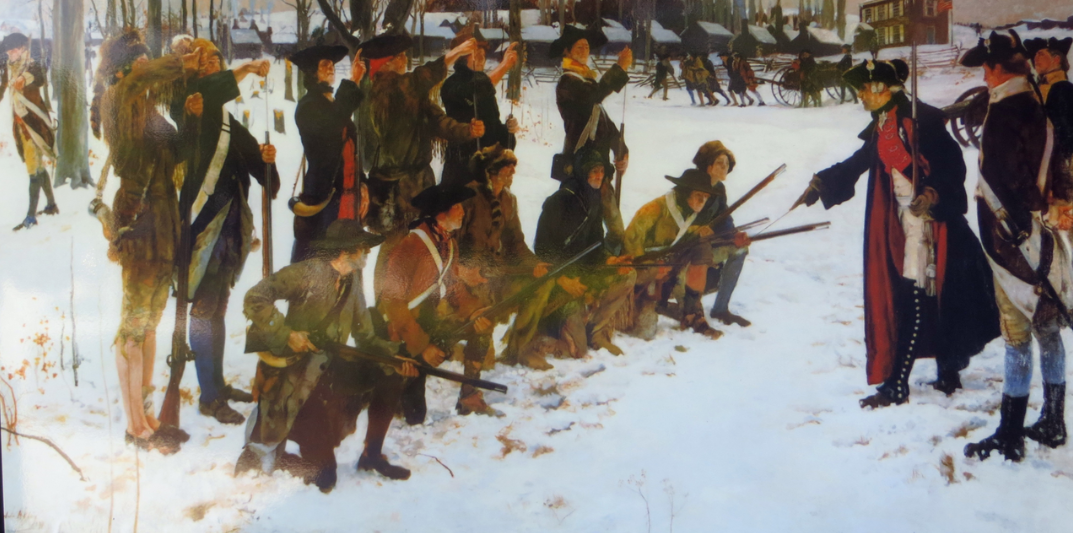
Image: Edwin Austin Abbey (1852-1911) painting of Baron Steuben drilling American troops at Valley Forge in 1778.
Written by Robert Barboza
Historical researcher Robert Barboza has written two books about local patriots in the American Revolution. His 2025 book, Patriots of the South Coast, and his 2014 history book, Patriots of Old Dartmouth, are available for purchase at the Westport Historical Society bookstore.
Includes Westport soldiers Jacob Mott (1721-1803) lived Yankee Bill farm on Pine Hill Road, William Hicks (b. 1729) lived on Adamsville/Cornell Road), Joseph Allen (1758-1838), lived on Drift Road.
Most local students of American history know that the men from their South Coast hometowns proudly served their country during the American Revolution, on the home front as Minutemen and regular militia members, and as Continental Army soldiers fighting on some of the most important battlefields of the war. This particular history lesson deals with the Continental Army infantrymen serving with the 14th Massachusetts Regiment, composed largely of militiamen from Bristol County. These citizen soldiers signed up for enlistments of one to three years in the spring of 1777 to reinforce General George Washington’s shrinking army as it retreat from pursuing British forces in New York.
Many of those who joined the regiment served during the famously terrible winter months spent at Valley Forge. Other local men served with the several other Massachusetts regiments in this colony to help the Continental Army continue its fight against the growing forces of Great Britain sent to the Americas to put down the colonial rebellion. This chapter focuses on the adventures of the 14th Massachusetts Regiment, which mustered in Boston and began the long march to New York in June 1777, arriving just in time to help prevent the American army retreating from Fort Ticonderoga from being killed or captured by British forces coming down from Canada.
The local soldiers sent to the New York battleground included Dartmouth’s Ephraim Keene, who was only 17 years old when he went on active duty, serving with Capt. Benjamin Dillingham’s First Company of the Second Bristol County Militia Regiment on local coastal defense duty. County militia records list him among the local militiamen enlisted on April 24, 1776 for a year’s service as part of the Continental Army.
The records show Keene had signed up for a second tour of duty with the Continental Army, a three-year enlistment with Capt. Joseph Wadsworth’s Second Company of Col. Gamaliel Bradford’s 14th Mass. Regiment, starting May 1, 1777. Continental Army pay records list him as dying in early 1778 at Valley Forge. Most of the American casualties that winter were caused by disease and inadequate food and shelter, not by the occasional skirmishes with the British army. In fact, throughout the war, more American soldiers died from disease and deprivation than from combat actions.
The Massachusetts regiment entered Valley Forge that winter with 407 men listed on its muster rolls. However, only 244 of the soldiers were deemed “fit for duty” in army records. When the Continental Army marched out of Valley Forge in the spring, only 185 of the 327 men left on the regiment’s muster rolls were reported as able-bodied and fit for active duty.
The 14th Massachusetts Regiment had been created in September 1776, gathering soldiers from five Massachusetts counties, including Bristol County to serve in the Northern Army of the colonies. The regiment saw action at the Battle of Saratoga, New York (1777) and the Battle of Monmouth, New Jersey (1778), and served until Jan. 1, 1781, when it was disbanded at West Point, New York.
Bradford’s regiment became one of the five Bay Colony regiments assembled into the Third Massachusetts Brigade, assigned to Major General Johann de Kalb’s Division of the Northern Army. The brigade was assigned to help oppose the British Army’s drive into central New York throughout the fall, helping the Americans win a decisive victory at the two Battles of Saratoga on Sept. 19 and Oct. 7, 1777. Surrounded by a flood of American reinforcements, and struggling to advance at the end of a long supply line, thousands of British troops under British General John Burgoyne surrendered after the second battle between the two armies. The surrender marked the first major victory over the British in the first two years of the Revolution, giving Americans a significant morale boost, and most importantly, helping to convince France to actively join with the colonies in the war against England.
British forces in the area retreated into New York City after the defeat at Saratoga. Washington moved his shrinking Continental Army into winter quarters in the little hamlet of Valley Forge. The men of the Massachusetts regiment remaining with Washington’s small army (only about 2,000 men) settled into hastily-built log huts to try to survive a brutal New York winter with little food, supplies, and no winter clothing due to logistical shortages caused by the lack of funds.
Some of the 244 soldiers in the regiment still deemed “fit for duty” lacked boots, and many of them covered their bare feet with rags when they were sent out on patrols or required to serve on guard duty. Many contemporary accounts note that patrols could be tracked by the bloody footprints left in the snow; some sources indicate that deadly diseases such as dysentery, running rampant through the close-packed huts in the American camp, killed more patriot soldiers than the British Army did that winter.
Capt. Amasa Soper of Dartmouth was among those soldiers at Valley Forge during that awful winter. He was in command of the 4th Dartmouth militia company at the start of the war, and again in 1776 when the company was sent to Boston to serve with Col. Thomas Marshall’s regiment. Soper served in Marshall’s 10th Massachusetts Regiment with the Continental Army at West Point from Dec. 21, 1776 to Feb. 10, 1777, and as a company commander in that regiment while serving at Valley Forge from December 1777 to June 1778. Capt. Soper earned his personal footnote in American history books while commanding his light infantry company during the assault on British positions at Stony Point, New York, captured by the patriots in 1779. He and his company went on to participate in the siege of Yorktown in 1781, which effectively ended the Revolution.
Jacob Mott was a Dartmouth militiaman serving with Capt. Thomas Kempton’s militia company at the start of the Revolution. Part of Col. Marshall’s regiment from Jan. 1, 1777 to March 1, 1779, he barely survived the brutal conditions at Valley Forge. Continental Army records show him as being transferred to the “corps of invalids” in Boston in May of 1778, probably as a result of illness contracted during his time at Valley Forge. Mott was officially discharged from that service on March 1, 1779, but payroll records for the 10th Mass. Regiment from Capt. Samuel King’s company stationed at West Point in January 1781 show 50 year-old Jacob Mott, described as “5 ft. 8 in.; complexion, dark; hair, dark; residence, Dartmouth” serving again with that unit. It seems that Mott had recovered enough from his illness to re-enlist for another term of army service.
Westport men serving with the Northern Army included Captain William Hicks of Westport, a member of Dartmouth’s 7th Company of the Second Bristol County Regiment of militia. The company was called up on Jan. 29, 1776 for active duty with Col. Jonathan Ward’s 21st Continental Infantry Regiment. The company took part in the Siege of Boston, parts of the New York campaign, and fought at the Battle of Trenton before being disbanded in January 1777. The Battle of Trenton took place on the morning of December 26, 1776, when Washington’s troops crossed the icy Delaware River in New Jersey for a surprise attack on the Hessian soldiers stationed at Trenton. It’s easy to imagine the Dartmouth men among the troops pictured with Washington in that famous painting showing them crossing the Delaware at night during a raging snowstorm to attack the British troops at Trenton.
Nearly the entire Hessian detachment defending the town was captured in that brief battle, while the Americans suffered few casualties in the surprise attack. Ward’s regiment was among those troops with expiring enlistments who left the army right after that historic battle, but the small victory encouraged some soldiers to re-enlist for another term of service. More importantly, the victory helped recruit more men to join the army for the first time, allowing the patriots to rebuild the Continental forces and continue the fight for freedom from Great Britain.
Some of the Massachusetts men volunteering for the Continental Army in 1777 and 1778 luckily avoided the terrible winter duty at Valley Forge, being stationed at various defensive positions along the Hudson River. The Americans had built a series of forts and artillery positions along the high banks of the river, effectively blocking British ships from carrying troops upriver to assault the patriot outposts. Many other Continental Army recruits stayed close to home, and were assigned to “coastal defense” duties in Massachusetts, Rhode Island, and Connecticut during their enlistments. William Hicks, for example, served as a captain with Col. Pope’s militia regiment, called out for a local alarm on Dec. 7, 1777, and later with Col. John Hathaway’s 2nd Bristol County Regiment, called up on Aug. 1-9, 1780, for emergency duty in Rhode Island.
Joseph Allen of Dartmouth served with the 7th Massachusetts Regiment of the Continental Army between 1777 and 1780, and he spent most of his three years of service in northern New York. The 7th Massachusetts was an infantry regiment of the Continental Army formed in late 1776 from seven companies of volunteers from across the state, eventually being merged into the existing 25th Continental Regiment. That regiment was assigned to the “Northern Department” in February 1777 and was sent to the New York Highlands as part of the 1st Massachusetts Brigade, and later, the New Hampshire Brigade of the Continental Army. When British General Burgoyne invaded New York from Canada, both the 14th Massachusetts Regiment and the 7th Massachusetts were dispatched to join the defense effort and took part in the Battle of Saratoga in the fall of 1777.
Besides crossing the Delaware with General Washington, or taking part in the defeat of the British at Yorktown, South Coast men had many opportunities to take part in the most historic moments of the American Revolution. A good example is Capt. Thomas Kempton, who had marched his militia company to Boston on April 21, 1775 for temporary militia duty, just after the outbreak of hostilities. He and his men remained there, taking part in the so-called Siege of Boston, until the fall of 1775. He and his troops were likely witnesses to the ceremonies held as General Washington took command of the new “Continental Army” and saw the first “American” flag being raised over the army that would fight long and hard over the next eight years to win independence for the American colonies.