
Russell Walters interviewed by Susan Montgomery
Posted on August 7, 2026 by Jenny ONeill
August 3, 2026
Listen
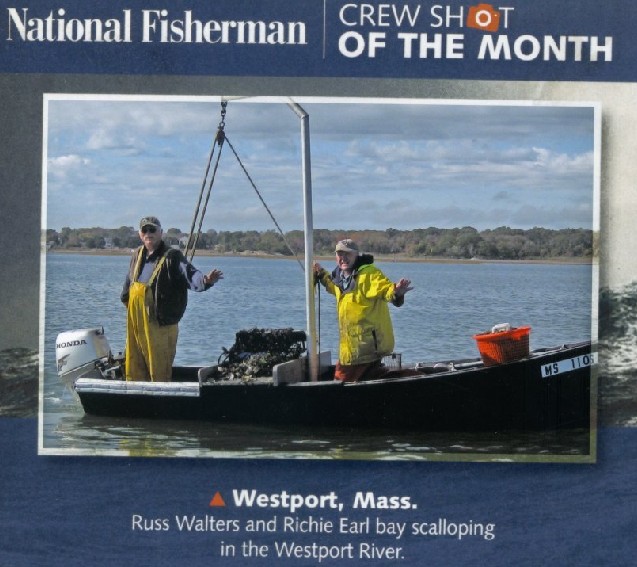
Richie Earle and Russell Walters bay scalloping in the Westport River skiff built by Tom (Deacon Earle) 1978
Transcribed using AI
Summary created by AI
This interview transcript features a conversation between Susan Montgomery (interviewer) and Russell Walters on August 3, 2026, in Westport, Massachusetts.
Key Summary Points
- Early Memories & Hurricane Carol: Russell first came to Westport as a young child with his mother to visit family friends. At seven years old, he experienced Hurricane Carol in 1954, recalling watching big waves at Bar Rock, evacuating to Fall River, and returning to find their rented cottage flooded, docks overturned, and a boat sunk.
- Youth & Westport Harbor: As a young teenager in the late 1950s and early 1960s, Russell spent extensive time in Westport Harbor with friends, spearfishing, hanging around Boathouse Row, visiting Lawton Farm, and riding bicycles or hitchhiking from Fall River.
- Settling in Westport: Around age 20, Russell and his friend Bobby Pierce converted a hen house on Pine Hill Road into a winterized apartment. After serving in the Navy, Russell built his home on Petty’s Heights in 1973 with his brothers and a retired carpenter named Joe Ouellette.
- Career Shift: Although he studied computer programming and worked as a bank loan officer, Russell left banking to pursue commercial fishing aboard the boat Sideshow with Richie Earle.
- Commercial Fishing & Innovations: Russell details the tight-knit commercial fishing community around the town dock and the transition to offshore lobstering up to 120 miles out. Key local innovations included Bob Haines of Pine Hill Equipment designing a specialized lobster trap hauler and switching to lighter wire traps.
- New England/Westport Clambakes: Russell describes the process of hosting traditional clambakes using layered wood, red-hot non-beach rocks, rockweed harvested from the river, and wooden mesh-bottom trays filled with sweet corn, potatoes, hot dogs, chouriço, fish, sausage, and clams cooked under wet canvases. He mentions his son Allen learned the craft from Ray “Rum Dum” Duvall (Devoll?) and carries on the tradition.
- Harvesting from the River: Over five decades, Russell gathered food from the local environment, including quahogs, scallops, oysters, sea bass, tautog, deer, and winter eels (often eaten with Gray’s mill johnnycakes). He also harvested herring for lobster bait.
- Town Changes: Russell reflects on the loss of open land and local farms to housing developments, the impact of Route 88 in opening up accessibility, increased river traffic, higher real estate values, and the growth of local organizations like the Westport Historical Society and the Grange.
(00:00:00) Susan Montgomery: This is Susan Montgomery. I’m the interviewer. My name is spelled S-U-S-A-N M-O-N-T-G-O-M-E-R-Y, and…
(00:00:15) Russell Walters: My… My name is Russell Walters, R-U-S-S-E-L-L W-A-L-T-E-R-S. We are speaking from Pettey Lane in Westport, Massachusetts.
(00:00:30) Susan Montgomery: Okay. So now, Russell, you and I have known each other for a while.
(00:00:35) Russell Walters: 50 years.
(00:00:36) Susan Montgomery: But that doesn’t mean that I know what you’re going to say when I ask you questions today, right? Otherwise, maybe I wouldn’t have picked you to be my first interview, but you’re my first interview. So, I’d like to start in the beginning, which is your earliest memories of when you were first—when were you first in Westport?
(00:01:00) Russell Walters: My mother was very close friends with two ladies, I think she went to high school with. One was Marion Pineau, who was the postmistress in Westport, and one was Barbara Schofield, who, um, family owned Smith Office Equipment in Fall River. So as a little, little, little kid—actually a baby—I started coming to Westport to visit Marion and Al Pineau. And I can remember having a cottage that Marion would arrange for us every summer for a few weeks or a month. One in the dunes in Westport, another off of Drift Road on the river. So that’s my first memories of Westport, plus Horseneck Beach.
(00:01:54) Susan Montgomery: So when you say in the dunes, there’s not any houses left in the dunes, are there?
(00:01:59) Russell Walters: No, and I can barely remember this. I remember walking from Baker’s Beach west, and there was a cottage there. And I have asked Richie Earle about this because he grew up on Earles Beach and Baker’s Beach, and he said, “Oh yeah, there was a cottage there.” So that’s where we went, but this was pre-Hurricane Carol.
(00:02:26) Susan Montgomery: Well, and you were pretty young.
(00:02:28) Russell Walters: I was about four then. I was seven in Hurricane Carol when we were on the river on Drift Road.
(00:02:35) Susan Montgomery: And do you remember Hurricane Carol?
(00:02:37) Russell Walters: Very well.
(00:02:38) Susan Montgomery: Tell me more.
(00:02:39) Russell Walters: Well, my father—the night before, we sat down at with Chandy’s or when it was Allens, I think, got an ice cream cone, and sat there and watched the great big waves break over Bar Rock. And, um, we went back to the cottage, we spent the night, and about 10:00 in the morning, my father had gone to work, he came to get us. And he said, “Come on, we’re getting out of here. The storm is much worse than we ever thought it was.” So we went back to our house in Fall River. When we came back, the water had been in the cottage, and that’s, you know, my memory. I remember the boat sunk in front of the house and the dock being tip, turned over, and so that was my real memory of Hurricane Carol.
(00:03:31) Susan Montgomery: Pretty dramatic when you’re seven years old.
(00:03:33) Russell Walters: It was cool. (laughs)
(00:03:36) Susan Montgomery: So, uh, then did you come back again when you were young?
(00:03:41) Russell Walters: Well, Barbara Schofield and her son was Drew, and he grew up right down the street from me in Fall River, but moved to Westport Harbor. So every time that Barbara and Andy went off on vacation or something, they’d send Drew to my house. And anytime that Barbara would reciprocate, I would spend three weeks maybe in Westport Harbor with them. I’m you know, maybe, I don’t know, 12, 13 years old. We’d take April vacation every year, and I’d go spend the week with Drew, and we’d go trout fishing. We’d—
(00:04:19) Susan Montgomery: So now when you say Westport Harbor, do you remember where the house was?
(00:04:23) Russell Walters: It was right—it was on Tee Lane, it was right next to the golf course. Um, and, uh, we, we had—I got to know all of the Harbor kids growing up. So I, I really, you know, it was almost like I grew up down here. And David Collins, who lived in Fall River, was a good buddy of mine, and we started out riding our bicycles from Fall River to Westport Harbor.
(00:04:55) Susan Montgomery: Really?
(00:04:56) Russell Walters: Yep, and we’d ride all the way home. We’d spend the day. We’d bring our—
(00:05:01) Susan Montgomery: That’s quite a long bike ride.
(00:05:03) Russell Walters: We’d bring our spear guns and all our equipment and go skin diving for the day. Two or three times we hitchhiked to Horseneck Beach and swam across the river to get to Westport Harbor. So we were in the mix of the kids way back in the, I would say, late ’50s, early ’60s, and right up through, you know, through high school. So I was very fortunate that I could grow up with that gang of kids as well as the gang in Fall River.
(00:05:32) Susan Montgomery: So what were the activities of that gang of kids, as you call them?
(00:05:36) Russell Walters: We spent most of our time spearfishing. That was the big thing that David and I were really into it, and there were a few other guys that were into it. We spent a lot of time doing that. We used to hang around the boathouses on Boathouse Row, with Everett Mills and Bob Hawes, and there was Drew Schofield, and the Fairchild girls, and it goes on and on. There was a real gang—just wonderful kids. The Lawton kids, and, um, we spent a lot of time at, um, the Lawton Farm. And, and that was really cool, hanging around there. We were just a bunch of kids having fun.
(00:06:17) Susan Montgomery: But you would go home to Fall River?
(00:06:19) Russell Walters: Yeah, sometimes. Sometimes I’d stay at Schofield’s.
(00:06:23) Susan Montgomery: So, how did you come to live in Westport? I mean, you’re living here, but, you know what I mean.
(00:06:30) Russell Walters: (sighs)
(00:06:31) Susan Montgomery: When it was your choice, and you could live where you wanted to live, where did you live?
(00:06:35) Russell Walters: Well, in my—I’d gotten to know Bobby Pierce from playing sports, and he played on a basketball team with me in Fall River, and we got to be really good friends. So I, in when I was, uh, I don’t know, maybe a sophomore in college, got a summer job working for Frank Kubik down here, carpentering. And Bobby and I decided we’d take one of his father’s old hen houses and make it into an apartment.
(00:07:05) Susan Montgomery: Now, where was this? Where was this?
(00:07:07) Russell Walters: It was on Pine Hill Road where the blueberry farm is.
(00:07:09) Susan Montgomery: Okay.
(00:07:10) Russell Walters: And, uh, the Pierce family was, was just absolutely wonderful to me. Um, Bill and Edna and Jim and Ginger and Bobby and Charlie and Sandy before he got killed, they were just wonderful to me. And, uh, they were a lot to helping me grow up. And, um, living there that summer and then we actually worked all winter, and we stayed out there in the cold all winter. We stayed in our hen house all winter. And it, it was really a good experience. So that was how I got to being in Westport.
(00:07:46) Susan Montgomery: So that was when you were…
(00:07:47) Russell Walters: That was, say…
(00:07:48) Susan Montgomery: …about 20, maybe? 20 years old?
(00:07:50) Russell Walters: Yeah, about 20 years old. Then I got—I had a—then I lived on Hicks Bridge Road. And, uh, then I went in the Navy, and I went back and forth to Hicks Bridge Road. And then I built this house on Pettey’s Heights in ’73.
(00:08:08) Susan Montgomery: And this is where we’re sitting now.
(00:08:10) Russell Walters: This is where we’re sitting now. Um, there was a retired carpenter named Joe Ouellette. He was an amazing man. And he and my two brothers and I built this house with a lot of friends helping.
(00:08:26) Susan Montgomery: Do you remember where Joe Ouellette lived in Westport?
(00:08:29) Russell Walters: He lived, um, on Drift Road where, um… (pauses) Where’s Sam live? What’s the name of the… No, what’s the name of the—Frog Hollow. He owned Frog Hollow and all of that, at the time.
(00:08:47) Susan Montgomery: And he helped you build this house?
(00:08:49) Russell Walters: He was amazing. He built the fireplace. He kept my brothers and I straight, you know. I had some experience working with Frank, my brother Gary graduated from vo-tech school, so we had a little idea of what we were doing, but Joe kept us straight. He, he was amazing. Even though he was 69 years old, too.
(00:09:12) Susan Montgomery: Well, it’s a beautiful house, and you’re still living in it.
(00:09:15) Russell Walters: Still here, 53 years.
(00:09:18) Susan Montgomery: Have you, uh, have you thought about, um, anything you would do differently if you were building the house now?
(00:09:23) Russell Walters: Yeah, we—
(00:09:24) Susan Montgomery: I mean, you were young when you thought about what you wanted your house to be.
(00:09:26) Russell Walters: We had a set of plans that we borrowed from somebody (laughs), and we modified them a little bit, and that’s how we built the house. I think I would build it a little different. I’d like to have a central chimney with a wood cookstove and that stuff, but this has been great. It’s been a very easy place to live.
(00:09:47) Susan Montgomery: What’s your favorite part about the house?
(00:09:49) Russell Walters: The, the den.
(00:09:50) Susan Montgomery: Which is where we’re sitting now.
(00:09:52) Russell Walters: Which is where we’re sitting now, with the fireplace, with the wood stove, and…
(00:09:56) Susan Montgomery: A big, a very large fireplace, open fireplace.
(00:09:58) Russell Walters: Yeah, six feet across and four feet high. And, um, just all my junk in here that I like to look at.
(00:10:08) Susan Montgomery: It’s a very interesting room, and can you—would you be willing to describe what—what’s in—would you—there’s some things in here, it would be fair to call them collections?
(00:10:18) Russell Walters: Yeah, there’s my collections of junk, so to speak.
(00:10:21) Susan Montgomery: Well, tell us what you’ve collected.
(00:10:23) Russell Walters: There’s some neat pictures of duck hunting or hunting with dogs and stuff. There’s a picture of Richie and Alan and I scalloping. There’s a great number of old baskets hanging up in here, an aquarium, there’s a lot of duck decoys, and there’s some old shotguns and rifles hanging around in here. And a bunch of furs.
(00:10:48) Susan Montgomery: Pelts.
(00:10:49) Russell Walters: Pelts, yeah.
(00:10:50) Susan Montgomery: Yeah, yeah. And what’s that thing hanging from the ceiling?
(00:10:53) Russell Walters: That’s a big hornet’s nest. (laughs) I found that when we were bird hunting up in New York. And it was in the wintertime, and they abandon them—I don’t know where they go in the winter—and it was kind of unusual because it didn’t come out of the bottom; they kind of had an odd shape to it where they came out of the bottom side of the nest. So I cut it out of the tree it was in, and nobody wanted it, so I brought it home and hung it up in my den.
(00:11:21) Susan Montgomery: Pretty interesting shape.
(00:11:22) Russell Walters: It’s cool. And there’s a deer skull that I found one day when I was deer hunting—a big buck that I found just a skeleton in the woods. There’s a taffrail log off of a sailboat. There’s a whole bunch of duck decoys that were given to me by Penny and Al Hadfield.
(00:11:42) Susan Montgomery: Well, I know you’ve always been interested in in the decoys.
(00:11:46) Russell Walters: Yes. Yes, and the duck hunting, waterfowl hunting.
(00:11:51) Susan Montgomery: Right, and, and they had, they had quite a collection, too.
(00:11:53) Russell Walters: They did. They still have—they still have quite a collection at Ben’s.
(00:11:58) Susan Montgomery: So, we want to talk—we want to talk about—we’ve been talking mostly about when you were first here and what it was like. And part of this project is to think about what’s changed, you know? So when you were here as a young man, building your own house, and, and what were you—were you working in Westport or somewhere else?
(00:12:18) Russell Walters: I was working, you wouldn’t believe this, as a, as a loan officer in a bank.
(00:12:24) Susan Montgomery: I believe it. I remember.
(00:12:26) Russell Walters: You remember, yeah. Going off in the morning in my coat and tie, and…
(00:12:30) Susan Montgomery: But, but why would you say that—that somebody might not believe it now?
(00:12:33) Russell Walters: I don’t know, it’s just the way I am, you know. It’s just… I’m more of the fisherman, farmer type person than than, um, than someone that worked in a bank, you know. I graduated from college with a degree in computer programming, and it was back in the punch card days. And I went in the Navy, and I came out of the Navy a couple of years later, and everything was different; I’d have to relearn everything. So that’s when I decided to do something different. They, they had had me at the bank before I went in wanting me to work in the computer room. But it was so different when I came out, I would have had to relearn everything, and I got doing that, and I wasn’t happy. And Richie Earle and Paul Brayton bought a boat called the Sideshow. And Richie said to me, “Why don’t you come fishing with me and go engineer?” So I said, “Well, I don’t know.” So he says, “Yeah, come on.” So I decided I quit my job at the bank, and I went fishing.
(00:13:38) Susan Montgomery: And who else was on the—well, I guess I should say originally on the crew at the Sideshow? This was in ’73, ’72?
(00:13:46) Russell Walters: I went the second year he had the boat. And, uh, it was Grant Moore, and Everett Mills, Richie and me, and a guy named Jeff Sailor from Dartmouth. Uh, Grant’s, um, gone on to be one of the all-time high-line lobster fishermen. Everett had an airplane; he flew spotting swordfish and stuff. And Richie went fishing for quite a few years before he had the survival company and then became, um, harbormaster.
(00:14:15) Susan Montgomery: So that really got you being down on the docks.
(00:14:18) Russell Walters: You know, being part of the people in Westport—the people of the fishing industry, the, the construction industry, and just the neat people that lived in town—um, that’s what I loved so much about it. I didn’t care if I ever left Westport! If I I didn’t care if, you know, Richie would say, “Well, you got to go to New Bedford and do this to get oil and stuff for the boat,” and I’d say, “Yeah, yeah, but I’d rather just stay here.” (laughs)
(00:14:42) Susan Montgomery: So, tell me something about those people back when you were—you were on more than one boat, so it wasn’t just the Sideshow. You spent a lot of time on the town dock where all the commercial boats are. Who are the memorable characters from then? To you, memorable to you?
(00:14:59) Russell Walters: Well, the real character—well, there was so many characters, you can’t, um… But there was a lot of people that were really nice to me. John Osborne that had the Sea King, he, he was a special guy. Um, Jimmy Hollis that had the June H, and Jimmy was a friend of mine up until he died when he was almost 70 years old, and he moved to Florida, but he used to come spend at least two or three weeks here with us every year. He was an unbelievable character—Ray Davoll, better known as Rum Dum. He, he was a special guy. And, and it goes on. Every guy, every one of those captains on the dock—Bud Smith, Dick Allen, uh, you know, John Borden, they were all just good to me. I can’t complain.
(00:15:52) Susan Montgomery: Do you remember the names of the boats back then?
(00:15:54) Russell Walters: Many of them, but, um, I wish I’d taken pictures of them. I have some pictures of the Sideshow, but that’s, which I’ve given to the Historical Society. And I wish I’d taken pictures of more of the boats.
(00:16:11) Susan Montgomery: Well, you mentioned the Sea King. What was Rum Dum’s boat?
(00:16:15) Russell Walters: Uh, the Fugawi. As amazing as that is, Scotty Fryer bought that boat, and he kept it in a boat shed for over 20 years. And just this year, 2026, a guy bought it, and he’s going lobstering with it.
(00:16:32) Susan Montgomery: And did he keep the name?
(00:16:34) Russell Walters: Kept the name.
(00:16:35) Susan Montgomery: And just in case someone can’t guess, what does the name mean?
(00:16:38) Russell Walters: Well, it was the Fugawi Indians—”Where the Fugawi?” They were lost all the time. (laughs) And that was Rum Dum’s boat. He was he was an unbelievably great man. Um, he did all the clambakes at the, uh, Little Compton Game Club, and at the Dartmouth Fire Department Number One, and a bunch of other places he put clambakes on. My son Allen started going to the game club with me when he was four years old or something. And now, 40-some years later, he does all the clambakes that Raymond taught him how to do. He spent a lot of time with Ray Davoll, and I remember when the kids were little, they used to say, um, “Here you go, Allen, you can light the fire, but don’t do this at home!” (laughs) Um, there’s so many people that were so good to us.
(00:17:34) Susan Montgomery: Well, a clambake—a real clambake.
(00:17:36) Russell Walters: A real clambake.
(00:17:37) Susan Montgomery: Which is what we’re talking about. We’re talking about the ones you mentioned, and there’s still…
(00:17:41) Russell Walters: We did one yesterday for a non-profit organization named Noom over at the game club.
(00:17:48) Susan Montgomery: So how does it start? Can you walk me through what it means? Oh, now that, I mean, Allen does it, but you’ve been there for this many times.
(00:17:55) Russell Walters: I’ve been there at this for 50 years. Uh, we’d start with some long logs, and we’d put newspaper and kindling wood between them, and then we’d bridge them across with a bunch of smaller logs, and then we’d put two more long logs, and we pile rocks in between them.
(00:18:14) Susan Montgomery: How big are the rocks?
(00:18:16) Russell Walters: Uh, not as—as big as a cantaloupe to maybe almost as big as your head.
(00:18:22) Susan Montgomery: And does it matter what kind of stone they are?
(00:18:24) Russell Walters: Yeah, they’ve got to be a certain stone. You don’t want to use beach rocks and stuff. You don’t want to use, um, marl and that. You just want to use regular old good old rocks. And you build it in layers. Now then, about, I don’t know, about three hours before you’re going to do the bake, you light the fire, and the rocks get red hot. I mean, they really get red hot. So in the meantime, we take these net bags and we put sweet corn, a bake—a potato, a sweet potato, a hot dog, an ear of corn, couple pieces of chouriço, a thing of fish, and some sausage in it. And then in another net bag, we put about, man, three quarters of a quart of clams. So when the fire is like—the rocks are red, we pull all the wood out of the fire, spread the rocks out, and we put about a foot of seaweed over it.
(00:19:25) Susan Montgomery: Now, how does the seaweed get there? Because this doesn’t happen at the beach.
(00:19:28) Russell Walters: We go down in the river and we pull the rockweed, put it in bags. And it doesn’t seem to hurt the rockweed, because there’s more next year than there was this year! So, and we—so that’s how the seaweed gets there. And we then we put the seaweed over the hot rocks, well, a good foot thick. And then we’ve taken and put all the clams and all the vegetable in trays—wooden trays with a mesh bottom—and we lay them on top of the seaweed. And when we get them all stacked in there, we cover it with a wet sheet and then a bunch of wet canvases, and we just cover the whole thing up and we let it cook for a little more than an hour, and there’s your clambake.
(00:20:12) Susan Montgomery: And that’s a real Westport clambake.
(00:20:14) Russell Walters: Well, that’s, yeah, a New England-style clambake.
(00:20:17) Susan Montgomery: Is there anything about the Westport ingredients that you put in those net bags that’s a little different than other places?
(00:20:22) Russell Walters: I don’t think so. Everything’s pretty much the same, you know. We probably use the chouriço, which I don’t think you get somewhere else, but it’s basically the same thing. We’ve done those over at the game club for over 40 years.
(00:20:38) Susan Montgomery: Is there another way that people in Westport have done clambakes when they don’t have a place outdoors or they don’t have much space? Is there another way to do it?
(00:20:46) Russell Walters: Well, you can do them in a barrel.
(00:20:48) Susan Montgomery: Yeah, what’s a barrel bake?
(00:20:49) Russell Walters: You just heat the rocks up, throw them in a barrel, put the seaweed on…
(00:20:52) Susan Montgomery: A barrel, what do you mean by it?
(00:20:53) Russell Walters: Like a 55-gallon drum-type size barrel. Harry Kirby used to use a great big cast iron kettle that he had, and you’d throw the hot rocks in it, throw the seaweed in it, throw your food in it, and then cover it up. That cooks that way. George Smith makes a lot of clambakes that way today, but in a big stainless vat he has.
(00:21:14) Susan Montgomery: I’m trying to remember the name. Who was it that used to do those sometimes up at Pine Hill Equipment? Buddy—Buddy Arel ?
(00:21:20) Russell Walters: Buddy Arel, yeah. He did a good job. But that’s, um, it’s just another way of doing it. You’re basically doing it the way the Indians did it, basically. They’d heat the rocks up and put the seaweed and make the steam, and the thing is incredibly hot. It is. Incredibly hot.
(00:21:40) Susan Montgomery: So, you think—when do you think was the first time you did a Westport clambake?
(00:21:45) Russell Walters: In ’70s, early ’70s. We used to do a lot of clam boils, too, but, you know, the real bake was sometime in the early ’70s.
(00:21:56) Susan Montgomery: And what else about the way Westport was back in the ’70s or the ’80s, those earlier years?
(00:22:01) Russell Walters: There was a lot more open space. Um, a lot of the farms now have been developed into housing projects and stuff. Spencer Tripp and I would go from the where the fairgrounds is now and hunt pheasants all the way down to where the Boy Scout camp was, almost down to the V in Pine Hill Road where Old Pine Hill Road and Pine Hill Road come together. We’d walk that whole shore and never see anybody, and nobody’d ever bother us.
(00:22:31) Susan Montgomery: And no houses near the shore?
(00:22:32) Russell Walters: No houses and nothing, you know. The few little places you’d go by, you’d just grab the dog and walk on by and they’d wave to you, and that was it. And it was the same way, you know, over here where I live, and nobody much bothered you. That was kind of nice, it was all open space. The river wasn’t nearly as crowded. Um, there’s a lot, a lot of people enjoying the river now that didn’t then. I think the fishing was better.
(00:23:01) Susan Montgomery: Why do you think the fishing was better?
(00:23:03) Russell Walters: Oh, there was a lot of reasons, you know: predators, and, uh, the amount of people fishing, and, you know, it’s just, it goes in cycles.
(00:23:14) Susan Montgomery: Well, what would you—when you’d go fishing back then, what would you expect to come home with?
(00:23:18) Russell Walters: Oh, we, we would—the tautog fishing was incredible. It really was incredible in the fall. The bass fishing was really good. Um, there weren’t as many bluefish in the earlier days. Quite a few fluke. That’s mostly what we fished for.
(00:23:36) Susan Montgomery: So you went fishing the other day. What’d you come home with?
(00:23:38) Russell Walters: A couple of sea bass. A few sea bass. We didn’t have a big day the other day, but we had a—we had a good time. Just being out on the water is just a good time. It’s not how many fish you catch, it’s being out there.
(00:23:51) Susan Montgomery: Well, when you say being on the water, that means you’re in a boat, right?
(00:23:55) Russell Walters: Yep.
(00:23:56) Susan Montgomery: So, what kind of boats have you had?
(00:23:58) Russell Walters: I’ve had mostly skiffs. I had a beautiful 18-foot V-bottom skiff that Mickey Orr built for me that was, uh, it was designed by Deacon Earle, Richie Earle’s brother Deacon. And he was an amazing man with boats. And I have a 16-foot wooden skiff made in 1978 by Deacon that I still play around in the river with.
(00:24:26) Susan Montgomery: Where did Deacon make those boats? Where was he building them?
(00:24:29) Russell Walters: Deacon’s boat shop was where the, uh, Prelude building is now, but it was—I guess it’s, um, condos now.
(00:24:38) Susan Montgomery: Yeah. So that’s—some people won’t know what Prelude is or the building. So you’re talking about a building that’s, um, just west of the Back Eddy, right?
(00:24:46) Russell Walters: Next to the restaurant.
(00:24:47) Susan Montgomery: Why do you call it the Prelude building?
(00:24:49) Russell Walters: Because Prelude was the great big lobster fishing company that built that building originally. Uh, I don’t—I think it was in the early ’70s, but they had some great big fishing boats, and they kind of pioneered the offshore lobster industry—one of the groups that did.
(00:25:08) Susan Montgomery: So when you say that, before the offshore, when people would go out in a lobster boat, would they just go out for the day?
(00:25:14) Russell Walters: Yeah, we would go as far as Coxes Ledge, which is about 30 miles offshore. And there was quite a boom of lobsters there at one time.
(00:25:22) Susan Montgomery: And how long would it take from like leaving the town dock to getting to Coxes?
(00:25:26) Russell Walters: About three hours. I went to Coxes with Harry Kirby on, um, the Dorothy M was the name of his boat. And Johnny Osborne used to fish down there, and Jimmy Hollis and Bud Smith. There was a whole bunch of guys from Westport that fished Coxes.
(00:25:44) Susan Montgomery: So when you were out there, could you see the other Westport boats?
(00:25:47) Russell Walters: On occasion.
(00:25:49) Susan Montgomery: And then how long would you be—you’d be hauling traps once you got out there.
(00:25:52) Russell Walters: Yeah, we’d leave at 4:00 in the morning and get in about just after dark, usually.
(00:25:57) Susan Montgomery: Long day.
(00:25:58) Russell Walters: Yeah.
(00:25:59) Susan Montgomery: So then you said Prelude, and that was started by Whipple, right?
(00:26:03) Russell Walters: Bill Whipple.
(00:26:04) Susan Montgomery: Bill Whipple. He—you said he started the going further offshore. What does that mean?
(00:26:09) Russell Walters: We went as far as 120 miles when we were fishing down in the canyons. There was a bunch of people out of Gloucester that, um, really got that started. And then Bill Whipple came down here—I can’t remember, I think the name of the boat was the Horizon—and he came down here, and Johnny Osborne came with him. And I can’t remember who, and he started fishing in deeper water. And he built the Prelude I and the Prelude II, and then he got into big steel boats, and they were really—I mean, catching thousands of pounds of lobsters.
(00:26:45) Susan Montgomery: And how long were they staying out?
(00:26:47) Russell Walters: Oh, three, four days. Maybe longer, I can’t—I don’t really remember, but they—
(00:26:50) Susan Montgomery: So that kind of a trip meant it had to be big enough for people to sleep.
(00:26:54) Russell Walters: Yeah, sleep—
(00:26:55) Susan Montgomery: And carry all the lobster.
(00:26:56) Russell Walters: Yep.
(00:26:57) Susan Montgomery: And what was the innovation? What made it so you could do that?
(00:27:01) Russell Walters: Well, there was a lot of things that changed. One of the things was the, um, the physical fishing equipment: the haulers and stuff to haul the traps. We would take and put up to 50 traps in one on one line, spread across the bottom, with a buoy on either end. So you had to have the capacity to lift that many traps off the bottom to the to the boat. You might have three or four traps suspended at one time, and get them onto the boat. And Bob Haines from Pine Hill Equipment designed a really, really nice lobster trap hauler that most all the boats got into using. And it was different. We had big four-foot traps, big four-foot wooden traps that were made by Anderson up in Maine—we used to call them bear traps. And they finally they got to building wire traps, which weigh a heck of a lot less and was a lot easier on your body. But that was the thing. I mean, there was a lot of lot of lobsters there.
(00:28:01) Susan Montgomery: You had to get out there.
(00:28:02) Russell Walters: Well, you had to get out there. You had to have a sea—
(00:28:04) Susan Montgomery: Did these new boats have bigger engines or…
(00:28:06) Russell Walters: Big—bigger boats. The Sideshow was 70-some—73 feet or 78 feet, something like that. That was a nice-size boat, and the Sea King was about as big, the United States was about as big. Bud Smith had some boats that were 50-some feet, and then they—then they went to a bigger boat, which was 60-some feet, and, you know, you went! You were gone two, three days sometimes.
(00:28:28) Susan Montgomery: So there’s the boats, which were changing, and there’s the fishermen, and how did that—what else, if you were living in Westport and you were part of that, what else was part of that community, that environment of fishing? Who else was in that?
(00:28:43) Russell Walters: Well, it was the guys buying the lobsters, of course, and the bait people, and the people that came and fixed the boats. There was a whole conglomerate of people that were around the town dock at that time. Um, I think one of the big things was the friendship amongst all the guys. Uh, everybody seemed to get along pretty well, and we were kidding around all the time and joking around and stuff, and it was a really, really good situation.
(00:29:13) Susan Montgomery: And were they—were they mostly Westporters besides the fishermen?
(00:29:16) Russell Walters: No, a lot of guys came—some guys came from Little Compton, some from Swansea. They were fishermen, though. They were guys that were fishermen or people who really wanted to be fishermen.
(00:29:26) Susan Montgomery: Well, you mentioned Bob Haines and Pine Hill. Who else was would they call on if they had a problem with something on—some need to be repaired on the boat?
(00:29:33) Russell Walters: Well, there was the engine repair guys, like there was Brodeur Caterpillar, there was Hathaway Marine, there was a bunch of different guys that came and worked on the engines. Um, we would go and haul the boat out once a year and have the—have it painted. We did that down in Jamestown, Rhode Island, but some guys went to New Bedford. Um, who else was working? There was the lobster buyer. Uh, yeah, Sweet Pea Hart did a lot of the welding on the boats. Um, and there was just a bunch of good people. Arthur Jannecke did a lot of the electronics. Um, there was another, Crust Electronics, did a lot of the electronics. The electronics then compared to today was kind of primitive, but it was better than what we had before, so… It was a—it was a good deal.
(00:30:26) Susan Montgomery: Well, I can hear—I can hear the fondness in your voice, um, and we have been talking about the fishing a bit, and I know you’ve contributed in the past to the Westport Historical Society program on that, and, um… But in that, in those years, back then, you know, it’s now we’re in 2026, so we’re 50 years later, right? What other ways—what other things have you seen change in Westport over that time?
(00:31:02) Russell Walters: Well, the fishing industry has changed, of course. Again, you know, I talked about how the farms have all disappeared, a lot of them have been developed and stuff, and there’s a whole new group of people that have come into town, and I don’t think they appreciate what we saw years ago. They’re different people, they’re not the same. But, you know, everyone that comes to Westport, even today with it, someone new that comes into town loves Westport. That’s a pretty cool part of it. Um, I don’t know. I really I can see all the change, but I don’t really know how to put it into words, you know, and it’s a lot of things have happened in town. Route 88, now that came in the early ’60s. That changed Westport probably more than anything that ever happened to Westport, because it opened it up to people. Before, how did you come to Westport? You came Main Road, or you came, um, down Pine Hill Road or something, Route 177 down Pine Hill Road, and when we used to come from Fall River, we would go down Sanford Road, 177, Main Road, and 88, I think, is the one thing that probably made the biggest change in Westport, because it opened the whole town up to you know, quick travel to get here.
(00:32:32) Susan Montgomery: So that sounds like a good thing.
(00:32:33) Russell Walters: Yeah.
(00:32:34) Susan Montgomery: Do you think at the time it was welcomed?
(00:32:36) Russell Walters: No. It was and it wasn’t. I don’t remember—I wasn’t involved in it. It was really when I wasn’t living here, but there was a lot of discussion about that. Horseneck Beach is another big thing that changed. When I was a little kid, it was all cottages all down the beach. We didn’t have the state in here, we didn’t have, you know, all of that involvement with it. We just had cottages, and they were cool. We had a place called the Midway, and there was Plant’s Pavilion, and there was Allen’s, and it was neat. It was a really neat place to be until the ’54 hurricane kind of wiped that out, and then it was I don’t know how many years later the state took it over.
(00:33:17) Susan Montgomery: And that’s when 88 was built?
(00:33:18) Russell Walters: That’s when 88 was built. And we got the new bridge, and so on and so forth.
(00:33:23) Susan Montgomery: Do you remember the old bridge?
(00:33:24) Russell Walters: Oh, yeah! (laughs) I never got to open the bridge. That was one thing that really disappointed me. Old Al Lee at Lee’s Wharf had the key that opened the bridge, and he’d get whoever was around to go out there and push the turnstile to open the bridge, and I never got to do that. I always wanted to open that bridge, and I never was around at the right time, it seemed, to get to do that.
(00:33:53) Susan Montgomery: Have you seen any pictures of that? Someone—I’ve heard this about turning the turnstyle and pushing it around, but I don’t know if I’ve ever seen a picture. Have you ever seen a picture of that?
(00:34:00) Russell Walters: I’ve seen a lot of pictures of the bridge, but not of them opening the bridge. The turn—the key, I think, is at the Historical Society. I remember, uh, Susan Pineau telling me she was there with, I think, the last time they opened the bridge, and pushing the thing, and, you know, how cool it was. But that—that was a that was a big change.
(00:34:25) Susan Montgomery: How do you think it changed the Point area?
(00:34:28) Russell Walters: I don’t know. The Point’s pretty much stayed a historical area, you know. It’s, um, the people have changed. If, um, if you sat with Richie Earle, he could tell you in the ’50s and into the early ’60s the name of every person that lived up and down Westport Point. He was the paperboy. And what, you know, who they were, what they were like. It’s amazing to sit and listen to him talk about, you know, who lived in this house and who lived in that house. It really is pretty cool.
(00:35:01) Susan Montgomery: It was very stable. I mean, people—families kept those houses generation after generation, and…
(00:35:05) Russell Walters: Oh, yeah. Oh, yeah. There’s been a big, I think, change down there now in the last few years. I think the people have gotten older for one thing, and the houses have been worth astronomical money. And a lot of people, I think, have just sold out just to—for the money. You know, you don’t talk hundreds of thousands of dollars now, you talk millions of dollars. It’s a major, major change.
(00:35:32) Susan Montgomery: Yeah, I think I I understand. Do you think there’s other parts of town that have changed that way?
(00:35:36) Russell Walters: I think so. I think Westport Harbor is really changed a lot. There’s been a lot of multi-million-dollar houses built down there in the last few years, and some of the larger pieces of land have been bought up, fortunately, though, by people who have kept them as larger pieces of land and built big houses on them. But it’s nice to see them not all cut up into little house lots, but they have kept as large pieces of land, because the open space is what makes it.
(00:36:06) Susan Montgomery: You think we still have the open space like you remember?
(00:36:08) Russell Walters: No.
(00:36:09) Susan Montgomery: Some of it?
(00:36:10) Russell Walters: Some of it, but not, you know, not a lot of it, not like we had. The farms were incredible when we were kids—just incredible. But it was a whole different community. It was a farming, fishing community. That’s what it was.
(00:36:28) Susan Montgomery: I remember the same. This is your interview, not mine, but I’m nodding along here because I remember how many farms there were when I came here in the early ’70s as opposed to now.
(00:36:39) Russell Walters: Yeah.
(00:36:40) Susan Montgomery: And there is open space, but…
(00:36:43) Russell Walters: It feels different.
(00:36:44) Susan Montgomery: It feels different. Some of the fields are overgrown, the fence lines even. When I came, they were farm—farmers kept their fence lines cleared, so there weren’t nearly as many trees.
(00:36:51) Russell Walters: You remember, too, ’54 hurricane, there were a lot of really big trees, and they got knocked over. And so now, we’ve seen the new trees coming back, and now we’re almost as many big trees as there were in ’54. And you look at it and you say, “Boy, I hope we don’t have another hurricane like that,” because—but it’s a cycle.
(00:37:16) Susan Montgomery: Has it changed your view from this house?
(00:37:18) Russell Walters: I could see Cadman’s Neck from this house when I when I first built this house, I could see Cadman’s Neck, and now I can see just across the street. In the wintertime I can see a little more. Everything’s grown up between here and there.
(00:37:33) Susan Montgomery: So… if you wanted someone who came here now to know what it was like here 50 years ago, what are the things you’d want someone to know about?
(00:37:50) Russell Walters: Well… the first thing I encourage everybody to do is join the Historical Society. Um, a lot of the new people who’ve come to town, I I’ve said, “You know, this is one thing you have to do: join the Historical Society, because then you can get a feel of the way Westport was.” Some of the talks and stuff they’ve had at the school or at the Grange have really, really shed a lot of light on what it was like in Westport years ago. And then I’ll tell people, “You know, that used to be this, and that used to be that.” And it’s a—they get a feel of it, but you have to have lived it to have truly gotten, you know, what it was like living here.
(00:38:35) Susan Montgomery: Is there a place you could take someone on the water or on land that would feel almost the same now?
(00:38:43) Russell Walters: Up in the West River. Some of that some of that land on the east shore of the West River, thank goodness, has stayed pretty much the way it always did, and, um, that’s pretty cool to get up in there and look around. And, um, you get north of Hicks Bridge, there’s a lot of little places in there where you can still see there’s some open property and stuff, but the West River is really Upper West River is where you can really show people what it was kind of like.
(00:39:19) Susan Montgomery: Now, I’m asking you this question because I kind of know! (laughs) I’m just thinking, you know, we talked about you fishing both commercially, but also you going out in the fish—your skiff and getting fish. But what else do you get out of out of this harbor besides fish?
(00:39:39) Russell Walters: Well, you know, there’s been years when there’s been a lot of scallops.
(00:39:41) Susan Montgomery: Oh, tell me about your first scallop year.
(00:39:43) Russell Walters: Oh, god! (laughs) We’ve had a lot of good scallop years.
(00:39:47) Susan Montgomery: But do you remember the first one?
(00:39:48) Russell Walters: First one was in the… Well, Bobby Pierce and I were good friends. Bobby Pierce grew up as a farm boy and also a fisherman with his father and his uncle, and Bobby Pierce taught me the river. He taught me how to go fishing, how to catch shellfish, and stuff like that. I mean, he taught me. And, um, the first couple of times I went scalloping, I went with Bobby. And, um, he taught me how to do it. I think was it ’75 was the first big scallop year? And, uh, I had my skiff, and I went scalloping that year. And then the next scallop year was somewhere four or five years later than that, and my wife at the time and I would go at daylight every morning, and, uh, we’d get whatever we could catch, we’d come home, she’d cut the scallops, and I’d go to work. And, uh, that was the second big year, and there were a couple years afterwards. The one that was about four years ago was unbelievable—was astronomical amount of scallops that there were.
(00:41:01) Susan Montgomery: It went on and on.
(00:41:02) Russell Walters: It went on and on, and went all the way into May.
(00:41:04) Susan Montgomery: What causes some years to be good and some not?
(00:41:07) Russell Walters: They’re a great mystery. (laughs) I think, um…
(00:41:10) Susan Montgomery: You got a theory?
(00:41:11) Russell Walters: Well, water salinity. The scallops have to be close to each other, because when one scallop starts laying eggs and the other start starts putting out sperm, they have to be close to each other so they know what each other’s doing! (laughs) And if not, one’s doing his thing, one’s doing his thing, and there’s nothing happening. But it just seems that some years the stars just line up right and there’s a lot of scallops.
(00:41:37) Susan Montgomery: Early on in the ’70s, I remember hearing a theory that if we had a real—if we had a moon tide in February and it was really cold, so it was a low tide that was really low, too close to the scallops, they’d get—that that would inhibit them.
(00:41:51) Russell Walters: That’s happened. Um, but I think a lot of it has got to do with like some of the guys said, if you have a drought year, well, you have a very steady salinity, because you’re not getting the big influx of rain and stuff. Um, those little embryos or whatever you call them, spat, float around for days. What’s on the surface of the water that kills them, you know? You just don’t know.
(00:42:15) Susan Montgomery: So that’s scallops. What else have you pulled out of this river?
(00:42:18) Russell Walters: Quahogs. A lot of quahogs.
(00:42:20) Susan Montgomery: You got a special spot?
(00:42:22) Russell Walters: Well, it’s changed a lot in the last couple of years. Uh, I can still catch quahogs, but it’s not like it used to be.
(00:42:28) Susan Montgomery: You think people share their special spots or keep them secret?
(00:42:30) Russell Walters: I keep my mouth shut.
(00:42:32) Susan Montgomery: (laughs) I noticed you didn’t answer me when I asked you that question.
(00:42:34) Russell Walters: I keep my mouth shut. The worst of it is you show somebody some place where you catch fish or scallops or stuff like—and I don’t mind sharing, but the next thing you know he’s there, his cousin’s there, his son’s there, you know, and there’s nothing left for me! I’ve always said I’d teach people how to fish, but I won’t show them where I fished. That was always my attitude: go find your places, I worked hard to find mine.
(00:42:57) Susan Montgomery: So, scallops, quahogs… Scallops and quahogs are the biggest thing, you know. How about mussels, are you a mussel eater?
(00:43:03) Russell Walters: No. There used to be the mussel flats.
(00:43:05) Susan Montgomery: Where were they?
(00:43:06) Russell Walters: They were west of Tripp’s Boat Yard. Right. And you could go pick up all the mussels you wanted there. And with this change of all the sand coming into the river, the mussel flats are probably a foot under the sand, and they’ve all been smothered. They used to pick mussels off the Point Bridge, but I was never too crazy of that because there was pressure-treated wood there and stuff. I was never too crazy, but there were a nice—they were a good mussel. Now they’re real, real little, I don’t know why. But there’s not the mussels there used to be. Um, outside of the harbor mouth, there’s a tremendous amount of mussels, but everyone’s got a crab inside of it. A little tiny crab inside of it.
(00:43:46) Susan Montgomery: Really?
(00:43:47) Russell Walters: They used to wash into the lobster traps when I was fooling around lobstering, and, um, you’d take them and you—I said, “Oh boy, these are going to be great!” Then you look at them, they have a little tiny crab inside of them, and I didn’t want anything to do with those. Um, but yeah, the quahogs and the and the scallops are the big thing. We used to catch a lot of eels in the wintertime.
(00:44:06) Susan Montgomery: Oh, you used to go eeling?
(00:44:07) Russell Walters: Through the ice, and we had these eel spears, and you’d cut a hole in the ice where you knew there were eels, like around the spring holes and stuff. There was a place off Cadman’s Neck, there was a place down, um, at the landing in the West River. There was a bunch of places you could go eeling. And there’d be a whole gang of guys out there, and we’d have a sled and you’d have an old wooden nail keg on it, and, um, you’d go jabbing your spear into the bottom, and you’d feel something like you hit a rubber tire or something, and pull it up and there’d be an eel on it. And eels and johnnycakes were a big—a big thing in the wintertime. Fred & Ann’s Restaurant, which is, um, Ten Cousins now, used to have eels and johnnycakes, I don’t know, one night a week.
(00:44:53) Susan Montgomery: Thursday night.
(00:44:54) Russell Walters: Thursday night, and if the wind was right, you could be all the way up at Lee’s and smell the eels cooking! (laughs) But, uh, that was—everybody had eels and johnnycakes, and…
(00:45:04) Susan Montgomery: What were the johnnycakes made with?
(00:45:06) Russell Walters: Cornmeal.
(00:45:07) Susan Montgomery: From down at the mill in Adamsville?
(00:45:09) Russell Walters: Adamsville, yeah. Yeah. That was a—that was a good mill for stuff like johnnycakes. I still make johnnycakes now and then in the morning for breakfast, but I don’t like the new—the other johnnycake meal as good as I like Gray’s meal.
(00:45:22) Susan Montgomery: How about herring? Do you ever go for herring?
(00:45:24) Russell Walters: We used to go herring in for bait—lobster bait. And we’d cut some for the roe, but the… I was more interested in bait. We used to set a seine… um, what was the name of that street? Up off of Pine Hill Road, one of those streets that went down in there to the river. We used to set a seine in there, and we’d catch herring by the bushel bags, and, um, we’d salt it for lobster bait. And then when we used to go up to, um, Brook Street in Rehoboth, Hermitage Factory, we had a whole bunch of places we used to go herringeing with a net we built.
(00:46:01) Susan Montgomery: Do you remember the herring run over on the harbor side?
(00:46:03) Russell Walters: Over on the harbor, right. We never did that much over there. We set a seine there a couple of times, but the one—how in the… The one that up off Pine Hill Road was by far the best place.
(00:46:15) Susan Montgomery: The herring run was for not for—where for, I think, if you just wanted a few, not if you were getting it to go for bait or something, and used to have a long pole with like a wire…
(00:46:25) Russell Walters: Yeah, you had a…
(00:46:26) Susan Montgomery: …and you just put it down in the herring run and then pick it—it was like scooping them up.
(00:46:29) Russell Walters: You had a net, but it was actually a piece of, um, wire screen, so it wouldn’t fold back through itself. We also used to go over Nanaquaket in Tiverton and dip them off the dam. But we would get quite a bit of lobster bait and salt quite a bit of lobster bait.
(00:46:44) Susan Montgomery: So between the lobsters and the fish, quahogs, scallops… how many meals do you think you ate out of this river in your life?
(00:46:58) Russell Walters: Oh, I couldn’t even begin to tell you! (laughs) I was alone one year here, and I didn’t have much money, and, um, I lived pretty much out of the river and what I hunted and stuff, and I was happy as can be. There was quite a few oysters at one time, also. There was a good—
(00:47:19) Susan Montgomery: Oh, we didn’t say oysters, right!
(00:47:20) Russell Walters: There was there was a good oyster fishery north of Hicks Bridge, and that was quite a fishery.
(00:47:26) Susan Montgomery: You could just walk out under the bridge there and…
(00:47:28) Russell Walters: Pick up oysters, yep. And, uh, that was quite a fishery. They were—they were delicious, too.
(00:47:33) Susan Montgomery: Do you remember the other oyster bed, the one the town used to lease to someone on the other river?
(00:47:37) Russell Walters: Yeah. That got killed. I don’t know what killed it, but that that got killed. And, um… But there’s—there’s a lot of places around with oysters. Um, there was quite a few right off of Pettey’s Heights here.
(00:47:50) Susan Montgomery: Really?
(00:47:51) Russell Walters: Yeah, but they—they’ve diminished, also.
(00:47:53) Susan Montgomery: So the oysters are where there’s a little fresh coming in…
(00:47:56) Russell Walters: That’s a good place to look.
(00:47:57) Susan Montgomery: …and the water’s got to be running, not still.
(00:47:59) Russell Walters: Sweet Pea and… I can’t—let’s see, Sweet Pea and Bud Smith and me and my son Allen, and at least four or five others , we moved oysters for, um, David Roach when he was the shellfish warden. Bobby Pierce, there was quite a bunch of us. We took our boats up north of Hicks Bridge when it was closed, and we dug all those oysters and moved them down off of, um, Great Island, and they never took. We’d hoped that they would take, and, you know, create a whole new…
(00:48:32) Susan Montgomery: New bed?
(00:48:33) Russell Walters: New bed, but there’s some oysters there, but there isn’t like what we hoped for. We probably moved a hundred bushels of oysters. It didn’t—it didn’t work out the way we’d hoped.
(00:48:42) Susan Montgomery: Well, getting your dinner out of the river in your backyard…
(00:48:45) Russell Walters: Yeah, that was cool.
(00:48:47) Susan Montgomery: Do you think a lot of Westporters do that now?
(00:48:49) Russell Walters: Not like they used to, but there’s still a lot of people that, you know, get a couple meals of fish a week and get a meal of oysters, and if they got a couple of lobster traps they might get a lobster or two, you know, and there’s a lot of people that still enjoy harvesting this stuff. Um, we have stuff in the freezer, too. We haven’t bought any fish in I can’t tell you how many years. We a lot of sea bass and stuff that we’ve frozen, and tautog, and, you know, we very rarely buy any red meat because I shoot a couple of deer every year, but that’s, you know, it’s changing some.
(Recording paused briefly, then resumed)
(00:49:28) Susan Montgomery: I have no idea how long we’ve been talking.
(00:49:30) Russell Walters: I don’t know, either. Well, it’s already what is it, 3:30?
(00:49:32) Susan Montgomery: Yeah, so it’s about… So I’m just trying to think of… So I’m thinking, Russell, of all the things I thought you would talk about… You—if I mention any name, you know that person, and you’re always mentioning people and acting like I should know who they are, and I don’t. You know everybody, and you remember people, and I’m just thinking: Are there people that you remember that other people don’t, and this is a chance for us to record it? Because you’re like a wealth of information about Westporters.
(00:50:06) Russell Walters: Yeah.
(00:50:07) Susan Montgomery: You and you and you always—you know, you have a… I mean, you mentioned Joe Ouellette, and I was hoping—I mean, and you mentioned Bob Pierce a lot, and, but I mean… and you’ve mentioned Richie, but everybody knows Richie, you know.
(00:50:20) Russell Walters: I mentioned Harry Kirby.
(00:50:22) Susan Montgomery: Did you say much about Harry Kirby?
(00:50:23) Russell Walters: A little bit, that I went on the Dorothy M with him. Johnny Osborne, Rum Dum.
(00:50:28) Susan Montgomery: Yeah, you did mention them. Sanford, what was…
(00:50:31) Russell Walters: Roger. Roger.
(00:50:33) Susan Montgomery: You don’t talk about him so much now, but you did at one time.
(00:50:35) Russell Walters: Yeah, they were good people. David’s still alive, Roger’s son. Barbara’s blind, she’s in Florida somewhere.
(00:50:44) Susan Montgomery: She’s blind?
(00:50:45) Russell Walters: Yeah, just about blind. She was about 60% blind in her left eye when I knew her. Right eye’s gone now. That’s hard. Um, I don’t know, I’ve mentioned a lot of the people that I… Think of anybody that later on you’re going to say, “Oh, I should have talked about…” Let’s give it a few minutes, let’s just think. I don’t know. I wanted to say a lot of nice things about the Pierces because they were so nice—so good to me, you know. I mean, I could—you can dig—you can sit around and dig names up like Bobby Wood. I’ve hunted with Bobby Wood for 50-some years, and, um, his father was a hell of a guy.
(00:51:24) Susan Montgomery: Do you guys hunt down here on their property?
(00:51:26) Russell Walters: Not so much on their property, but we’ve hunted all over everywhere, Bobby and I have. I don’t know. We’ve said quite a bit when you think about it.
(00:51:35) Susan Montgomery: Are you okay with what we’ve said?
(00:51:37) Russell Walters: Yeah, when you play it back and listen to it, you may…
(00:51:40) Susan Montgomery: Well, I’m just trying to think before while I’m here, because I got you here. But you’re right. I mean, we covered a lot.
(00:51:50) Russell Walters: I mean, you could talk about the Point Church. I mean, I’m not a member there, but all the good things they do down there: the Boy Scout troop when it was there, and…
(00:51:59) Susan Montgomery: Oh, we should—you could do that, because you’re not the kind of person that they’d expect to have say something like that.
(00:52:04) Russell Walters: Um, Allen was an Eagle Scout, you know.
(00:52:07) Susan Montgomery: Okay, let me just think about how to… Let’s let’s think a little more. Um… So, moving away from fishing and other things about Westport…
(00:52:19) Russell Walters: Well, we’ve talked about the Historical Society and how I felt, you know, the people should come with that. Um…
(00:53:31) Susan Montgomery: Or how about the hatchery?
(00:53:33) Russell Walters: We built the hatchery on the town dock, and, uh, now it’s been reopened.
(00:53:37) Susan Montgomery: It’s going to be reopened?
(00:53:38) Russell Walters: It is reopened, they tell me. See, I don’t—I don’t have my wheels, so I can’t get down there and see what’s going on and stuff, you know. (laughs)
(00:53:46) Susan Montgomery: How about the church on the Point?
(00:53:48) Russell Walters: The church on the Point’s done a lot of wonderful things, you know, with the Boy Scouts and all the other little activities that go on down there. Uh, you know, it’s a real community thing. They used to have square dances, they have good music down there, on top of, you know, the religion and the church. The kids all went to Sunday school there, and that’s, uh, always been a good thing. The Grange is really come back into life again.
(00:54:14) Susan Montgomery: Hasn’t it?
(00:54:15) Russell Walters: Ed Hockey had a lot to do with that, and Beth. She wanted a place to do her dance, you know, and Ed got interested in it, and he got Diamond Vocational in there, and they completely redid the whole outside of it and everything. Ed is one smart guy, and he grew that back again, you know, and he did really a really good job of making that back to what it was, you know. Not—it was different way back, I guess, than what we ever could imagine.
(00:54:43) Susan Montgomery: Before our time.
(00:54:44) Russell Walters: Before our time. All the farmers had their meetings there and everything, you know.
(00:54:49) Susan Montgomery: Well, we’ve been talking for quite a while now.
(00:54:51) Russell Walters: Yep.
(00:54:52) Susan Montgomery: Covered a lot of ground.
(00:54:53) Russell Walters: Yeah.
(00:54:54) Susan Montgomery: Of course, as soon as we as soon as I put this away and we think about it, one of the others is going to think of something.
(00:54:59) Russell Walters: You know, Susan, you can sit and listen to that and think about things, and I’ll think about things, and we can just do a little more.
(00:55:07) Susan Montgomery: Okay.
(00:55:08) Russell Walters: Add on to it. I got no, you know…
(00:55:10) Susan Montgomery: It’s a deal.
(00:55:11) Russell Walters: Yeah.
(00:55:12) Susan Montgomery: Okay. Off.