
The RI privateer Swallow sought sailors in Acoaxet
Posted on March 2, 2026 by Jenny ONeill
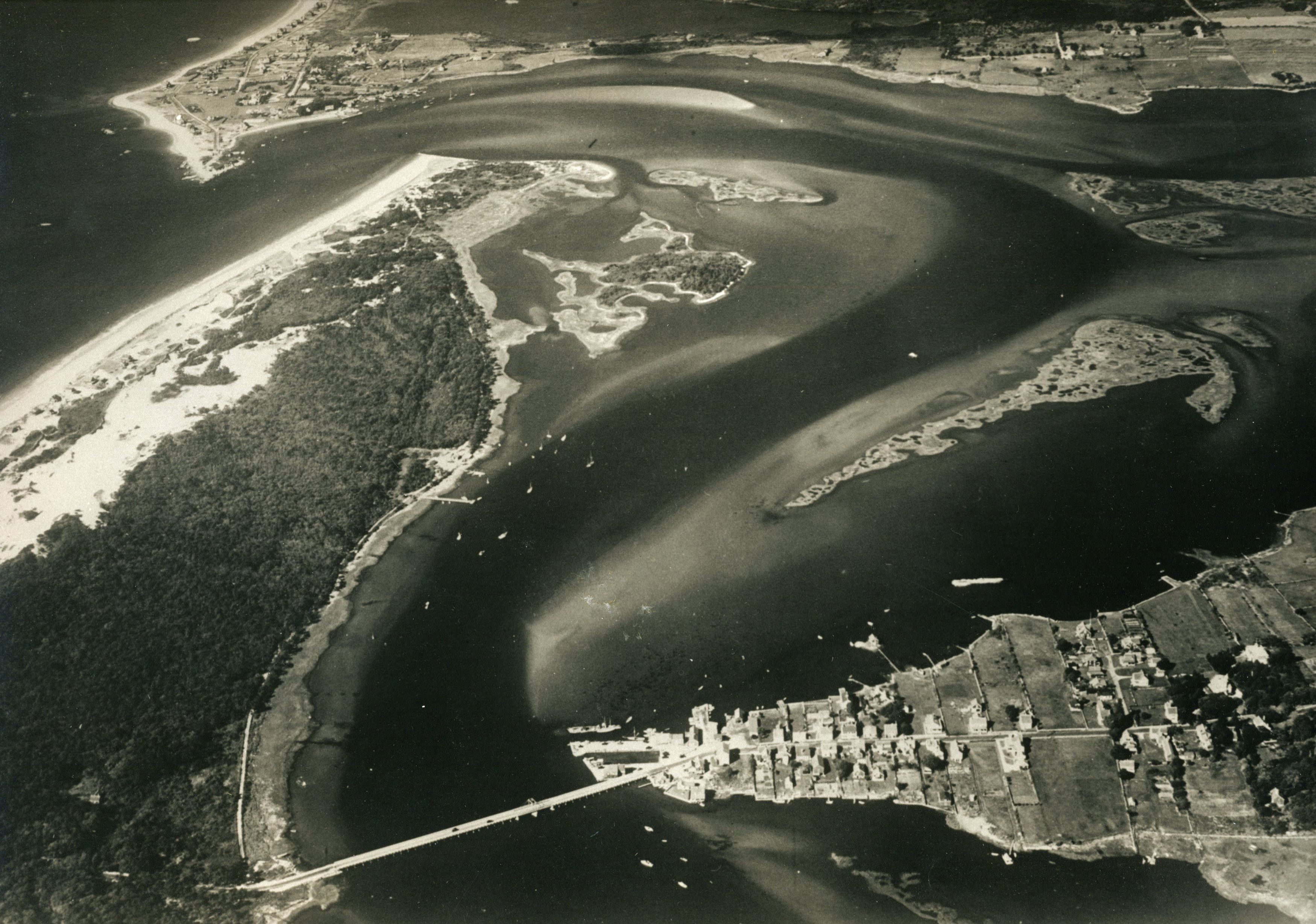
Photo pre 1938 showing Westport Harbor, known during the Revolutionary War era as the Devil’s Pocket Hole
Written by Robert Barboza
Historical researcher Robert Barboza has written two books about local patriots in the American Revolution. His 2025 book, Patriots of the South Coast, and his 2014 history book, Patriots of Old Dartmouth, are available for purchase at the Westport Historical Society bookstore.
The story of the Rhode Island privateer Swallow includes one of the few mentions of Acoaxet, as the westernmost part of present-day Westport, Massachusetts was known in 1777, in the long and interesting maritime history of these parts during the American War for Independence. Swallow was a small trading sloop owned by John Innis Clark of Providence, Rhode Island, and his brother Jeremiah, successful merchants who were partners in the prominent shipping firm of Clark & Nightingale.
The Clark brothers delivered the appropriate cash bond to the Rhode Island legislature and Swallow was officially commissioned as a privateer vessel, authorized to attack and seize British vessels and property on the high seas, on July 11, 1777. Captain Benjamin Seabury, a veteran of the coastal trading fleet, was listed as the commander of the six-gun sloop in the commissioning papers, and Tiverton, Rhode Island sailor and militiaman David Gray was named as the vessel’s first lieutenant.
Swallow was outfitted with six small cannon and a handful of swivel guns, which were miniature cannons mounted on the ship’s rails used to rake enemy decks with dozens of musket balls at a time. The little sloop would stand little chance of surviving a fight with a Royal Navy warship, but had enough cannon and swivel guns to convince small unarmed British merchant ships to surrender without a battle. Privateer vessels were usually heavily over-manned, needing enough extra sailors aboard to dispatch small “prize” crews onto each captured ship to sail it to a friendly port. Sometimes though, the captured ship would merely be plundered of anything of value and sent on its way, otherwise unharmed.
Unfortunately, the British had occupied Newport by the summer of 1777, and was using its harbor as a naval base for the Royal Navy ships blockading the important port of Providence, and effectively shutting down the bottom half of Narragansett Bay. On dark and stormy nights, privateer vessels, blockade runners, and the occasional Continental Navy warship would risk the Royal Navy patrols and sneak down the bay to reach the ocean and begin their particular missions. So did Swallow sneak out of Providence one suitably dark night not long after the ship’s commissioning, bound for the target-rich waters of the West Indies.
First, though, the sloop turned into quiet Acoaxet Harbor to take on water, food supplies, and some trading commodities that could be sold in the West Indies. Captain John Murphy, not the Captain Benjamin Seabury listed on Swallow’s privateer’s commission, was reported as commander of the vessel. Captain Murphy certainly filled out a thin crew with some of the experienced seamen available in that little port because the British coastal blockade had stifled the coastal trading industry and left many sailors unemployed. State records show Swallow in Acoaxet on Aug. 13, 1777, with a crew of 30 men aboard, ready for a quick voyage to Caribbean waters.
The maritime research website American War for Independence at Sea (https://awiatsea.com) entry on Swallow quotes from the captain’s log in Royal Navy archives: “Swallow sailed from Acoaxet (near Dartmouth) Massachusetts, probably in August 1777, bound for Cap Francois, Saint-Domingue with a cargo of fish, oil and lumber. On 12 September 1777, some twenty-four miles northeast of Turks Island, Swallow was sighted, at 0700, by HM Frigate Aeolus (Captain Christopher Atkins)… A brief chase began, involving much gunfire from Aeolus. Murphy threw his guns overboard to escape, but Swallow surrendered at 1145.”
Captain Murphy and 27 crewmen were taken prisoner and shipped to the Royal Navy base in Jamaica for trial and transport to an English prison. Doing the math from the reported crew list, at least three or four patriot sailors were apparently killed by fire from Aeolus, as there were only 27 seamen listed in British Admiralty reports of the Americans’ trials. British Admiral Clark Gayton described Murphy in the trial proceedings as a “notorious pirate” despite the privateer commission. The British did not recognize rebel privateer commissions as legitimate authority for their warlike actions, and treated captured privateer crews as common pirates, not as prisoners of war. For that reason, they would not exchange captured privateer crewmen for British sailors taken prisoner by the patriots. That approach would later change as the British began employing its own privateers to help the Royal Navy, and to interfere with American shipping.
Admiral Gayton charged that Murphy had planned to sell Swallow’s cargo in the West Indies, and use the funds to buy weapons and hire men for raids on British settlements in Jamaica. The admiral was likely acting on intelligence of past blockade running activities by Clark & Nightingale ships. Swallow was not the first Rhode Island trading/privateer vessel sent to West Indies ports to trade goods for the military supplies needed by the colonials and state militias, as the following permit sent to Clark & Nightingale the previous year illustrates.
“Permit for Clark & Nightingale, 19 September 1775
Issued by Gen. George Washington
Camp at Cambridge Sepr 19th 1775.
Whereas the Necessities of the Army under my Command for Amunition are so great as to require all Possible Supplies, and Messrs Clark and Nightingale Merchants of Providence, having represented to me, that they will at their own Risque, undertake to procure from the West-Indies or elsewhere, such Quantities as may be purchased, provided they obtain my Permission for this Purpose, I do therefore hereby make known to all Committees and other Persons whatsoever, that the Voyage now proposed by the Sloop Fly and the Sloop Neptune are for the above purpose and undertaken with my Privity & approbation, under such Restrictions and Engagements, as the Honorable Govr Cooke of Rhode Island shall think proper, to prevent the same from being perverted to any other Purpose than that above Specified. And I do recommend it to all Committees & other Persons, not only to forbear molesting or intercepting them on the Voyage aforesaid, but to give them all Assistance and Countenance in their Power.
- (The Papers of George Washington, Revolutionary War Series, vol. 2, University Press of Virginia, 1987, pp. 14–15.)
Whatever trading or military mission Swallow was on that fall, it failed miserably. According to British records, Captain Murphy and his crew were convicted of crimes against Great Britain and included on a list of prisoners sent to Forton Prison in England in January of 1778. The New Englanders were fortunate not to be among the thousands of colonial sailors who died in British custody due to starvation, mistreatment, or disease. In July of 1778, Murphy and several other members of Swallow’s crew were reported as escapees from the British prison. In the Franklin Papers in the National Archives, there is a copy of an August 1778 letter that Captain Murphy wrote to American commissioner in France Benjamin Franklin, seeking assistance in finding a friendly ship to bring them home.
Murphy’s letter indicated he and nine others had escaped the prison on July 28, making their way to the coast. There, they somehow found the means to cross the channel, arriving in Boulogne, France on August 9. July when with 9 more maid my Escape and on the 9 of August Arrived in Boulogne And Shall stay here a few Days,” Murphy wrote. With Franklin’s assistance, the escapees eventually made it back to New England before winter.
A genealogical site for the Gray family of Tiverton confirms that ancestor Lieutenant David Gray was captured by the British in late 1777 and imprisoned in England. “He escaped and, by traveling at night, was able to get to the coast and over to France where he got money from Benjamin Franklin for passage home,” the family website reports. Gray returned to the maritime trades upon his return, surviving the dangerous life he had chosen until late 1783, when he died while serving on a merchant ship. Like many other sailors far from home in those days, he was buried at sea. Among those captured crewmen who never made it out of Forton Prison was fellow Tiverton sailor Philip Cory, Gray’s wife Nancy’s younger brother. Cory died in 1778 of a fever contracted in prison.
According to Murphy family lore (via a family research site), the patriot also served on the Continental Navy frigate Deane at some point in the war, and had twice escaped from the British – once from Forton Prison, and once from the British prison ship Jersey in New York harbor. Continental Navy records indicate that Deane sailed from early 1779 until late 1783, but make no mention of his confinement as a prisoner during that service.
John and Jeremiah Clark are in Rhode Island archives as owners of the privateer Joseph, as well as a number of merchant vessels that may have done double duty as privateers during the War for Independence. John Clark also partnered again with Joseph Nightingale in the commissioning and outfitting of the Rhode Island privateer Hope. Nightingale was a well-to-do distillery owner, and Clark & Nightingale was one of Rhode Island’s most successful merchant companies in the pre-war triangle trade in molasses and rum from the West Indies. He and his father Samuel Nightingale were war partners in the privateer frigate Blaze Castle.
THE BLAZE CASTLE
The Blaze Castle is worth mentioning for a local connection. Captain James Munro was sailing back from the West Indies, steering for Bedford Harbor in Dartmouth in early June 1778, when they encountered the British warship Unicorn, commanded by Captain John Ford. From a starting point south of St. George’s Bank, Unicorn started chasing the Rhode Island ship at 1400 hours (3 p.m.), and three hours later, was finally close enough to take action.
At 1900 hours, Unicorn fired the first cannot shot at Blaze Castle. The privateer immediately hoisted an American flag, then hauled it down to indicate surrender. The captured ship and crew arrived at the Royal Navy base at Halifax, Nova Scotia, on June 15 under a British flag. Quick negotiations for the exchange of Yankee sailors saw Munroe sent to Newport as part of a cartel exchange for British prisoners after only a few months of confinement. Monroe later served as captain of the privateers Joseph and Hope. In April of 1781, he was commissioned as captain of the Massachusetts privateer Belisarius, which he was commanding when it was captured by two British frigates that fall.
This time, Munroe and the other Americans captured were taken to New York for imprisonment. His fellow captive Ebenezer Robinson described their experience aboard the Jersey, the most notoriously vile of all the British prison ships: “Our sufferings while confined in this old hull of a ship were unaccountably severe, and many of our number perished on account of the stench, the damp deathly atmosphere in which we were confined, and the miserable food which was furnished us, whereby to support life.”
More patriot sailors and soldiers would die of disease, starvation, and infected wounds in British custody than were lost in action against the enemy. Most of those held on the prison ships did not live to see the freedom earned by the revolution. More research is needed to try to discover if Munroe, Robinson and other local men aboard Belasarious when it was captured managed to survive their time on the prison ship.