
Paul Cuffe’s Activities During the Revolutionary War
Posted on March 6, 2026 by Jenny ONeill
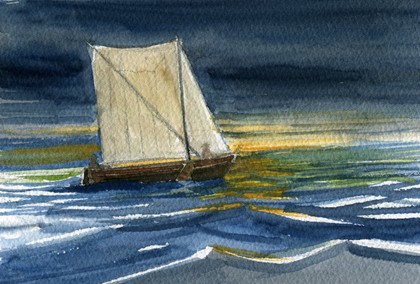
Image: Paul Cuffe Nearing Nantucket after a Night at Sea
Resolving Some Lingering Questions
David C. Cole
Paul Cuffe was just sixteen years old in 1775 when the Battles of Lexington, Concord and Bunker Hill occurred, and he was reportedly at sea on a whaling voyage during those events. He set forth on another whaling voyage in 1776, but the ship was apprehended by the British Navy and Paul was confined to the miseries of a prison ship in Brooklyn for three months. After gaining his freedom, he returned to the family farm in Dartmouth that had been willed to him and his brother, John, after their father’s death in 1772.
Over the next six years, while the war was ongoing, Paul Cuffe engaged in two major activities that were emblematic of his character and precursors of his future achievements. The first activity that he was focused on throughout the war was to deliver much needed supplies to the people of Nantucket – predominantly Quakers – who were seeking to follow their religious traditions and not take sides or participate in the war. They were subjected to a blockade by the British Navy, as well as harassment by Privateers and Pirates.
The second activity that he engaged in with his older brother, John, and other free mixed Native/African friends and neighbors, was to seek clarification of their rights as Free Persons of Color as to whether they could vote for their representatives and participate equally in their governance. Their efforts in this regard took place mainly in the years 1780-81 and included petitions to both the Massachusetts Legislature and Dartmouth Town Authorities.
Recently two eminent Historians have cited the activities of Paul and John Cuffe and their father, Cuff Slocum, a freed slave, as symbolizing fundamental issues that were being confronted both locally and more broadly by many of the inhabitants of North America at that time. The first issue was the forced merging of three major continental cultures – Native, English/European and African – along the eastern third of North America. The second was striving to create for the first time ever a representative democracy.[1] This high-level academic attention to several local historic figures of our community provides a strong message and incentive for us, here and now, to revisit their stories to see what we may have missed and how we might more appropriately recognize their continuing significance. Commemorating the 250th anniversary of these times provides an additional incentive and opportunity to do so.
Delivering supplies to Nantucket
The best reference describing Paul Cuffe’s wartime supply trips to Nantucket that we have found is Daniel Ricketson’s book, History of New Bedford, published in 1858, 80 years after the actual events.[2] Ricketson lived all his life in New Bedford where he practiced law and built friendships with Henry David Thoreau and other notables of his era. His recounting of Paul Cuffe’s wartime activities mentions many of the same events that are described in the “Memoirs of the Life of Paul Cuffee,” attributed to Paul’s friend, James Brian of Wilmington, Delaware, and published in several local magazines when Paul visited England in 1811. Ricketson’s account notably omits the adulatory digressions in the original Memoirs.[3] A slightly condensed version of Ricketson’s description of Paul Cuffe’s efforts to bring much-needed supplies to the people of Nantucket is as follows:
“At the age of twenty (1779), Paul, in company with another brother of his, David, built a boat…. David…having never been at sea,..became so much alarmed for their safety that Paul was obliged to return with him. Soon after this Paul undertook a trip to Nantucket with a boat-load of produce, but in crossing Buzzard’s Bay was seized by “refugee pirates,” who robbed him of his boat and cargo. Nothing daunted, in connection with his brother, before mentioned, they built another boat; and having procured a cargo upon his credit, Paul again started for Nantucket, and was again chased by pirates; but night coming, he escaped from them, but ran his boat upon a rock on one of the Elizabeth Islands, and so badly injured her as to render it necessary for him to return to his home on the Westport River. After having repaired his boat, he again set off for Nantucket, reaching there in safety this time, and disposed of his cargo to good advantage. On a subsequent voyage, however, he was again taken by the pirates and deprived of all except his boat. Still he continued his trips to Nantucket until he had acquired enough to look for a more lucrative business.”
We believe this passage from Ricketson’s book accurately describes some aspects of Paul Cuffe’s supply runs to Nantucket during the Revolutionary War period, but it is open to challenge on several important points.
Which brothers collaborated on the Nantucket runs?
Ricketson, and most other chroniclers of Paul Cuffe’s activities at this time, claim that it was Paul’s brother, David, who helped build the boats used to transport goods to Nantucket, but who also was overwhelmed by the risks of running the British naval blockade, privateers and pirates to reach Nantucket.
David Cuffe was the oldest of Paul’s siblings, born in 1747 and married to Hope Page, a Native woman of Freetown, in 1771. There are indications that David Cuffe and his bride took up residence in her family home on a reserved area in Freetown where they soon began having children.
Another possible partner and supporter on the Nantucket runs was Paul’s brother-in-law, Michael Wainer, a Native man who had married Paul’s older sister, Mary in 1772. Michael and David were nearly the same age, 12 years older than Paul, but Michael had been to sea on whaling and other ventures many times whereas David had not. Michael was also possibly living with his wife’s family and helping her younger brothers, John and Paul, manage the family farm from 1772 to 1776. He may also have had a hand in arranging for Paul to join three whaling trips in 1773, 1774 and 1776.
Most importantly, Michael and Mary Wainer, in 1776, purchased a property at the center of Russell’s Mills and set up a tanning business there on the bank of the Paskamansett or Slocum River. That same year the British Navy was imposing a blockade on American shipping in Buzzards Bay and the South Coast of New England. The Russell’s Mills site provided the safest and closest spot on the South Coast for mounting Paul’s voyages to Nantucket. Whether Michael joined Paul on any of these risky trips, or just helped Paul find crew members to go with him, is unknown, but it seems highly likely that he was the main brother (i.e., brother-in-law) who helped Paul procure ships, gather cargo and carry out the Nantucket deliveries, and that those operations were based at Michael and Mary Wainer’s home and tannery at Russell’s Mills.
A second issue in Ricketson’s discussion of Paul Cuffe’s voyage to Nantucket when Paul’s boat was damaged while trying to flee from pirates, he says that Paul “returned to his home on the Westport River.” There are several problems with this statement. At that time, perhaps 1777-78, the Town of Westport did not yet exist – it was separated from Dartmouth in 1787 – and Paul’s family home and farm were some distance from the Acoaxet River which some decades later was renamed the Westport River. Paul acquired a property on the Acoaxet River in 1789 and built his boatyard and home there during the 1790s. He most likely returned with the damaged boat to his support base at Russells Mills on the Slocums River where he could enlist brother-in-law Michael Wainer’s support in making the repairs.
The following map shows a possible route from the mouth of the Paskamansett River in Dartmouth, through Quick’s Hole in the Elizabeth Islands, around the south side of Martha’s Vineyard and then across to either the north or south shore of Nantucket. This route offered many coves on the Elizabeth Islands and the southern shore of Martha’s Vineyard into which Paul might have ducked to hide from pursuing ships. His shallops, equipped with “lee-boards” that could be easily raised to permit access into very shallow waters or passage over shallow sandbars would have facilitated his escapes.
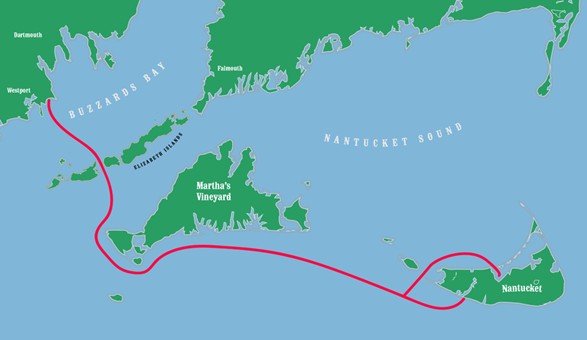
Map of South Coast with Possible Route from Dartmouth to Nantucket
Where did he get his boats for the Nantucket run?
With respect to procuring the boats for the Nantucket runs, most chroniclers state that Paul, either alone or with his brother, David, built the boats.” The Memoirs of Paul Cuffee,” a w document attributed to James Brian and published in the Belfast Monthly Magazine in 1811, state that at age eighteen, Paul, together with his older brother, David, “procured an open boat and proceeded to sea.” But then “for the first time, his brother found himself exposed to the perils of the ocean,” and demanded to cancel the venture. This is the only version of this story that uses the term “procured.” All subsequent versions claim they built the boat.
Given the conditions along the South Coast at that time, most notably the British Naval blockade, the prevalence of pirates and privateers patrolling the waters and capturing prizes, it seems highly likely that most local owners of small craft hesitated to venture out into open waters and simply kept their boats at their docks or on shore. It is our view that Paul Cuffe and his family members, having tended the sheep of many of these Dartmouth farmers for over 15 years on the Elizabeth Islands, had established good relations with them and that those who owned small boats would have been willing to loan their idle craft, even for such a risky venture when it involved delivering supplies to their Quaker friends on Nantucket, an act consistent with their philosophy of “doing good.” The fact that Paul lost at least two such boats to pirates may have caused some of the owners to regret their decision, but it is unlikely that they pressed Paul for reimbursement so long as he kept trying to deliver supplies to the Nantucket Quakers.
It is also possible that Paul’s brother, David, may have been involved in building one of the boats for Paul’s use. David was the oldest child of Cuff and Ruth Slocum, born in 1747 and then living on Cuttyhunk Island with his family from 1750 to 1767. Cuff and, in time, his sons were undoubtedly most engaged in managing the hundreds of sheep that were brought from the mainland during the warmer months for grazing. There is no mention of what these male members of the family did during the winter months. We can assume that Ruth and her daughters were busy carding, cleaning and spinning wool yarn and using it to make clothing for the whole family. It also seems reasonable to assume that the male family members during the winter were busy repairing and perhaps even building new small boats that they could use themselves or sell to others to earn income. David, who was 20 years old by the time the family moved from Cuttyhunk to the farm in Dartmouth, had ample opportunity to learn the trade, whereas Paul, who was only 8, did not.
As for the type of boat Paul was likely to have built or borrowed, we have some indication from the story reported in the Slocum genealogies that Holder Slocum in 1737 had a shallop and lent it to a Quaker Minister, Thomas Chalkley, to sail from Dartmouth to Nantucket to hold a meeting with Quakers on that island. Holder Slocum was also the owner of the western Elizabeth Islands where Paul Cuffe and his family lived and worked for the Slocum family and their friends from 1750 to 1767. Paul’s father, Cuff Slocum, probably used one of Holder Slocum’s shallops to travel between the islands and to the mainland. Furthermore, Holder Slocum’s widow, Rebecca, when she died in 1773, recorded in the inventory of her estate “a ferryboat lying at Christopher Slocum’s wharf together with her anchor, rigging, sails and appurtenances” valued at 43 Pounds. This would be a reasonable description of a shallop. Christopher Slocum was her son and inherited the islands from his parents. This shallop was probably still available in 1777 when Paul might have needed to borrow it, or Paul and David used it as a model for building a shallop.
How many trips to Nantucket did he make?
The several narratives of Paul Cuffe’s supply trips to Nantucket describe the ones on which he was captured and lost his supplies, his money and sometimes his boat, but most do not say more about the successful runs such as how many there were or how long they continued. Only Ricketson states:
“Still he continued his trips to Nantucket until he had acquired enough to look for a more lucrative business.”
This suggests both that Paul made numerous trips and that once he had accumulated enough earnings from these trips, he stopped doing them and moved on to “a more lucrative business.” If one of the main motivations for Paul Cuffe to undertake these very hazardous ventures was to bring much needed supplies to his Quaker friends on Nantucket, it is at least conceivable, and perhaps more likely, that he continued the deliveries until the war ended and the Naval blockade terminated sometime in 1782 or 1783. The book by Edouard Stackpole, Nantucket in the American Revolution, indicates that the people of Nantucket faced severe shortages of food and other essential commodities throughout the War despite efforts by local shipowners to breach the blockades and the pirates circling about them. If that was the case, then there probably were both the need and sufficient reward for Paul Cuffe to continue his Nantucket trips. Once the war had ended and the blockades removed it would have been more reasonable to look for more lucrative and less risky coastal trading possibilities, which is what we believe Paul Cuffe did.
It seems likely, however, that he continued some form of the Nantucket supply runs for as long as the blockade and other threats lasted, or perhaps for the six years 1777-1782. He probably also timed his travels to avoid severe weather and bright moonlight. If he averaged only one trip a month over the six years, that could have amounted to over 70 such trips. Even half that number is a lot, and twice that number – two trips per month, or 140 overall, would be huge in comparison to the impressions of just a few such trips suggested by the chroniclers. We can’t say with any degree of certainty how many trips he did make to Nantucket throughout the War, but, given all the statements as to Paul Cuffe’s commitment and dedication to the cause of helping his Quaker friends, the higher numbers may not be unreasonable.
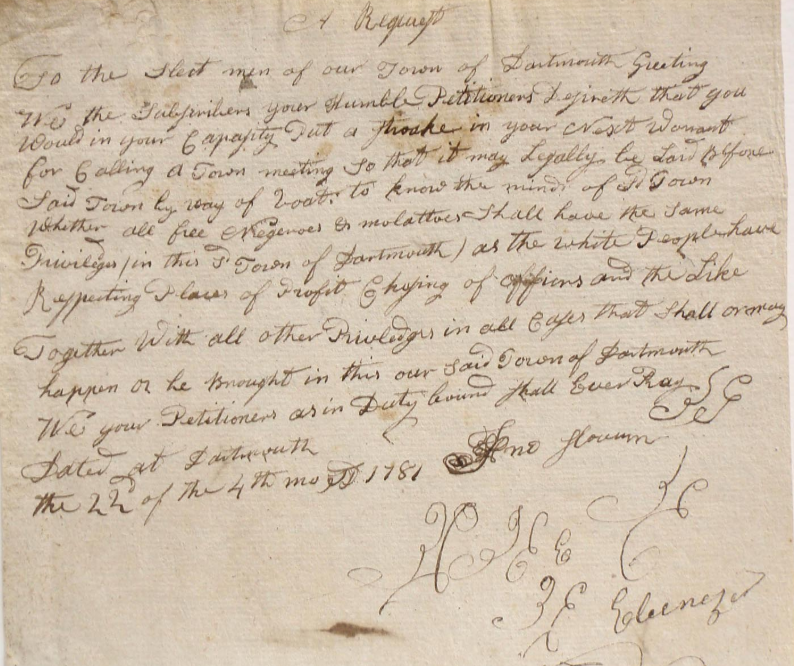
The petitions for equality
Ricketson also provides one of the better descriptions of John and Paul Cuffe’s efforts to either gain voting rights or be freed of the burden to pay taxes, as follows:
“On his third (whaling trip), he (Paul) was captured by a British ship, during the war of the Revolution, about the year 1776, and was detained three months as a prisoner in New York. After his release he went to Westport (Dartmouth) and worked at farming for two years. During this time, Paul and his brother, John, were called upon by the collector of the district for the payment of a personal tax. This they for some time refused to do, upon the ground of their not possessing the full right of citizens; but being peacefully inclined, they finally paid the demand, and then sent in a petition to the Legislature, representing the injustice done to the free colored people in this particular. Their petition created a considerable excitement, as well as debate, and was strongly opposed by a few; but a large majority were convinced of the reasonableness of their claim, ‘and in defiance of the prejudice of the times, the Legislature passed a law rendering all free persons of color liable to taxation, according to the ratio established for white men, and granting them all the privileges belonging to other citizens. This was a day equally honorable to the petitioners and the Legislature—a day which ought to be gratefully remembered by every person of color within Massachusetts; and the names of John and Paul Cuffee should always be united with its recollection.’”
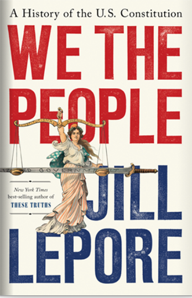
In a recently published book, We the People: A History of the US Constitution, Harvard historian Jill Lepore presents a new interpretation of the US Constitution focusing particularly on the “philosophy of amendment,” or as she describes it:[4]
“The U.S. Constitution was intended to be amended. “The whole purpose of the Constitution,” Supreme Court justice Antonin Scalia once said, “is to prevent a future society from doing whatsoever it wants to do.” This is not true. One of the Constitution’s founding purposes was to prevent change. Another was to allow for change without violence. Amendment is so essential to the American constitutional tradition, so methodical and so entire a conception of endurance through adaptation, that it can best be described as a philosophy. This book, a history of the Constitution, argues that the philosophy of amendment is foundational to modern constitutionalism. Amendment is also a constitution’s mechanism for the prevention of insurrection. This book aims to chronicle the origins of amendment, to identify the conditions under which amendment is possible, to examine why the practice of amendment has been abandoned, and to reckon with the question of whether the Constitution can endure without it.”
She then proceeds to illustrate this philosophy by recounting Massachusetts history and bringing in the stories of Paul and John Cuffe as early practitioners of it.
A core principle established in Massachusetts during its ferocious constitutional debates in the 1770s and ’80s is that a constitution has no authority over people who have no hand in writing, ratifying, or amending it. “Law to bind all must be assented to by all,” as one town meeting put it. This raised the important questions of whether men who were denied the right to vote, and therefore were unable to participate in town meetings, were bound by the constitution, or whether there were ways other than by voting in a town meeting to assent to, or to amend, a constitution. Once again the best evidence is to be found in petitions, a form of political participation open to all. In February 1780, Paul and John Cuffee, brothers from the coastal town of Dartmouth, submitted a petition to the Massachusetts legislature. The Cuffees were the sons of a Wampanoag woman from Cape Cod and an Akan man, born in West Africa, who had been sold into slavery in Massachusetts and was later manumitted. Both brothers had been born free. They owned a farm and had begun a whaling business. Because of their color, they could not vote. In their petition, which they submitted not only on their own behalf but on behalf of Black men who had been born into slavery, they began by noting the disadvantages of “having been deprived of enjoying the profits of our labor or the advantage of inheriting estates from our parents, as our neighbors, the white people do.”
They then argued that “having no vote or influence in the election of those that tax us,” they were subject to taxation without representation.
Paul and John Cuffee did not participate in Dartmouth’s town meeting over whether to ratify the new state constitution. But they managed to participate in the debate all the same. At the time when the Cuffees submitted their petition to the state legislature, town meetings all over Massachusetts, including some near Dartmouth, were preparing objections to the new constitution’s property requirement—an estate worth sixty pounds, or an annual income of three pounds—for voting. The town of Mansfield asked whether it could really be that “thousands of honest, good members of society shall be subjected to laws framed by legislators, the election of whom they could have no voice in?”
The 1780 Massachusetts Constitution, unlike the failed 1778 constitution, said nothing about “Negroes, Indians, and mulattoes.” In its new Declaration of Rights, it announced that “all men are born free and equal” and, borrowing from the Pennsylvania Constitution, stated that “all elections ought to be free; and all the inhabitants of this commonwealth, having such qualifications as they shall establish by their frame of government, have an equal right to elect officers, and to be elected.” (John Adams, in his original draft, had included the word male before inhabitants, but this had been deleted during deliberation at the constitutional convention, and significantly, no one proposed adding the word white.) Nonetheless, whether men who were not white could vote remained ambiguous. Paul Cuffee would later claim that, in response to their petition, the Massachusetts legislature had “passed a law, rendering all free persons of colour liable to taxation, according to the ratio established for white men, and granting them all the privileges belonging to other citizens”—including the right to vote. Later historians have been unable to locate any such law passed in Massachusetts in the 1780s. Other records claim that the state’s supreme court issued this decision.
Perhaps the best explanation is that Paul Cuffe meant that he and his brother, in their petition to the legislature, had told Massachusetts what its new constitution meant: they themselves had conducted an act not of constitutional amendment but of constitutional interpretation. When Paul Cuffe wrote that, in response to the petition, the State of Massachusetts had granted to ‘all free persons of colour . . . all the privileges belonging to other citizens,’ he meant that he had, in effect, told the state how to read its own constitution.”
While Paul and John Cuffe were undoubtedly representing the position of not just their co-signers on the petitions, but more broadly of all free persons of colour (sic), Lepore’s statement that they claimed their petition had contributed to passage of such authorizing legislation in Massachusetts in based on a misunderstanding. The source of this claim is the document entitled: Memoirs of Captain Paul Cuffee: A Man of Colour. While this document is called a memoir, perhaps written by Paul Cuffe, in fact it was not written by him. The document first appeared in 1807 and was published by The Abolition Society of Delaware. It was probably written entirely or mostly by James Brian of Wilmington who had sailed with Paul Cuffe several times between Canada and Delaware transporting plaster of Paris. He presumably had lengthy discussions with Paul Cuffe while they were at sea and decided, perhaps with Cuffe’s agreement, to record his version of “The Memoirs” in the Bulletin of the Abolition Society of Delaware. The “Memoirs” are so loaded with self-adulatory phrases about Paul Cuffe that it is obvious they were not written by a person of his modesty. Thus, to attribute them as being statements made by Paul Cuffe, as Lepore does, is unreasonable. On the other hand, her suggestion that the Cuffe Brothers’ petition to the Massachusetts Legislature may have helped the Members to better understand and interpret their own words seems reasonable.
Who were Paul Cuffe’s mentors?
We have stated that Paul had been involved in two major activities during the War: delivering supplies to the people – mainly the Quakers – of Nantucket and seeking equal treatment on taxation and the right to vote for free blacks like himself, his brother, John, and several of their friends. In both these activities Paul had prominent local supporters who were very helpful in achieving his objectives.
The “Nantucket runs” built a relationship with two members of the most prominent family in Nantucket at that time that continued to aid and influence many aspects of Paul’s activities for the rest of his life. These were two Rotch family members – William, Sr. and William, Jr. They were leaders of the whaling operations on Nantucket before the War and then moved to New Bedford after the War. They were also leaders in the Quaker community and prominent pacifists who refused to support either side in the War. They were almost certainly supporting Paul Cuffe’s efforts to bring supplies to Nantucket during the War. Subsequently they were financial backers of Cuffe’s international trading business.
William Rotch, Jr. was the same age as Paul Cuffe, and they obviously became very close friends. When Paul Cuffe died in 1817, William, Jr. delivered the eulogy at his funeral at the Westport Friends Meeting and was the executor of his will, a process that continued for over a decade.
When Paul and his brother John refused to pay taxes on their farm in 1780, as noted previously in the quotations from Ricketson, they were charged with a crime and imprisoned briefly in the county jail in Taunton. They reached out to Walter Spooner, a local political figure who was frequently elected Moderator of Dartmouth Town Meetings and, according to Ricketson (p. 331), “was also at one time Chief Justice of the Court of Common Pleas for the County of Bristol.”[5] Spooner was able to help them reduce their tax liability, which they then paid and were freed from the Taunton jail.
There is an often-reported story illustrating the friendly and respectful relationship between William Rotch, Sr. and Paul Cuffe. It occurred after Mr. Rotch had attended a Friends Meeting in Westport and was invited to dine at the Cuffe home on the Acoaxet River along with some other Quaker friends. As the guests approached the dinner table, William Rotch, Sr. noted that there were only enough chairs for the guests and announced that he would only join the company if the host and hostess would also join them, which they did. It is difficult to imagine a clearer example of a local leader of the English/American/Quaker community providing living testimony of his own belief in equality and mutual respect for a local leader of the African/Native community.
Our summary of Paul Cuffe’s activities during the War
- During the first year of the War, 1776, Paul started out on a whaling ship that was captured and the crew imprisoned on a prison ship in Brooklyn for three months.
- After his release, he returned to the family farm in Dartmouth and began exploring the means of bringing supplies to the Quaker population on Nantucket.
- He may have enlisted the support of his oldest brother, David, to build one or more shallop-style boats, a skill his brother might have learned from helping their father, Cuff Slocum, during the winters that they spent on Cuttyhunk Island 1750-1767.
- Or Paul may have arranged to borrow an idle boat, probably a shallop, from one of the Slocum families that owned large homestead farms along the lower reaches of the Slocum River.
- He probably based his operations at the home of his sister and brother-in-law, Mary and Michael Wainer, at Russells Mills, which was the closest available and safe water-accessible location to Nantucket.
- He also probably worked with members of the Rotch family in Nantucket and New Bedford to fund purchase of the cargos to be taken to Nantucket.
- On several of his attempted trips to Nantucket, he was apprehended by pirates, privateers and British naval vessels that took his cargos and sometimes his boats.
- However, over the six years of the War, he probably became much more knowledgeable of the risks and safe havens along this route and was able to make numerous successful trips delivering supplies to Nantucket and accumulating sufficient earnings to launch a coastal shipping business after the War ended.
- In 1780 Paul and his brother, John, were presented with a tax bill that they initially refused to pay because they did not have the full rights of citizens. After interventions by Walter Spooner, a prominent local citizen, they agreed to pay a reduced amount and were freed from prison.
- Paul and John also petitioned the Massachusetts Legislature and the Town of Dartmouth to either grant them full rights of citizenship or relieve them of the obligation to pay taxes.
- While some writers have claimed that these petitions eventually contributed to including provisions for voting rights in the Massachusetts constitution, this is probably not correct as explained by Jill Lepore in her book on the forming of the US Constitution.
[1] See Fischer, David Hackett, African Founders: How Enslaved People Expanded American Ideals. New York, Simon and Schuster, 2022. Also, Lapore, Jill, We the People: A History of the U. S. Constitution. Norton, 2025.
[2] Ricketson, Daniel. The History of New Bedford. New Bedford, 1858.
[3] “Memoirs of the Life of Paul Cuffee, the Interesting Negro Navigator.” The Belfast Monthly Magazine, Vol. 7. No. 39 (Oct. 31, 1811).
[4] Lepore, Jill. We The People: A History of the U. S. Constitution. 2025.
[5] According to a biography on the Find A Grave website, Spooner attended Quaker Meetings but was not a member because he believed that defensive war, like the American Revolution, was sometimes justified.