
Abner Brownell: Westport’s Paul Revere
Posted on January 26, 2026 by Jenny ONeill

Westport’s Revolutionary Stories
A well educated young man’s conflicted response to the war, attracted by the promise of promotion and admiration, and yet constrained by his Quaker beliefs.
The story of Abner Brownell (1756-1851) – “Westport’s Paul Revere” – has been handed down through the generations. Its origin and authenticity remain unknown but it first appears in the writings of Gladys Gifford Kirby, author of many articles on local history. She pursued a career as a teacher and librarian and was appointed principal of Westport Factory school. Although her source for the story about Abner Brownell is unknown, her deep knowledge of Westport’s history adds an element of authenticity. But, unfortunately we may never know how accurate it is!
According to Gladys Gifford Kirby, in April 1775, Abner Brownell “Came to tell the people of our town that war had begun, and that all the minutemen must start for Boston immediately. Now everything was hustle and bustle for within a few hours two companies of the Dartmouth minutemen were on their way to Boston.” (History of Westport by Gladys Gifford Kirby)
The details of Abner Brownell’s ride are lost to history. It may be that Abner Brownell was part of a chain of alarm riders, as outlined in David Hackett Fischer’s book on Paul Revere’s Ride. “A major event happened that night in a way that was profoundly different from the popular image of solitary hero-figures.” (David Hackett Fischer)
These riders – the many local and nameless Paul Reveres– spread out across the state. We do know, for example, that Dedham, a town to the south of Boston, did not receive word until 9 AM in the morning of April 19. It is unlikely that minutemen were able to set out immediately from Dartmouth. As documented in a pay roll of the minute company which marched from Dartmouth it was not until April 21 that a company set out under the command of Thomas Kempton.
The wishful narrative of an immediate response is echoed in Leonard Bolles Ellis’s History of New Bedford (1892) who relates a story of Captain Thomas Kempton in New Bedford:
“I well remember,” says John K. Cushing, grandson of the commander, Capt. Thomas Kempton, “hearing my mother tell the story as she heard it from my grandfather’s lips, how, when the news arrived in town, he was at work upon his new house, situated on what is now Thomas street. He was at work on the outside of the building when the alarm was brought to him (and it must have been conveyed to him by the swift rider) as the chief military man of the village. ‘You must take care of everything now, for I am going to camp at Roxbury,’ he said to his family, as he hastened away to muster his company of minute men. One of the neighbors took grandfather’s horse, and away he went carrying the startling news into Rhode Island.”
In reality, Kempton needed time to muster his soldiers. But within two days of receiving the alarm, the company was on their way to Roxbury.
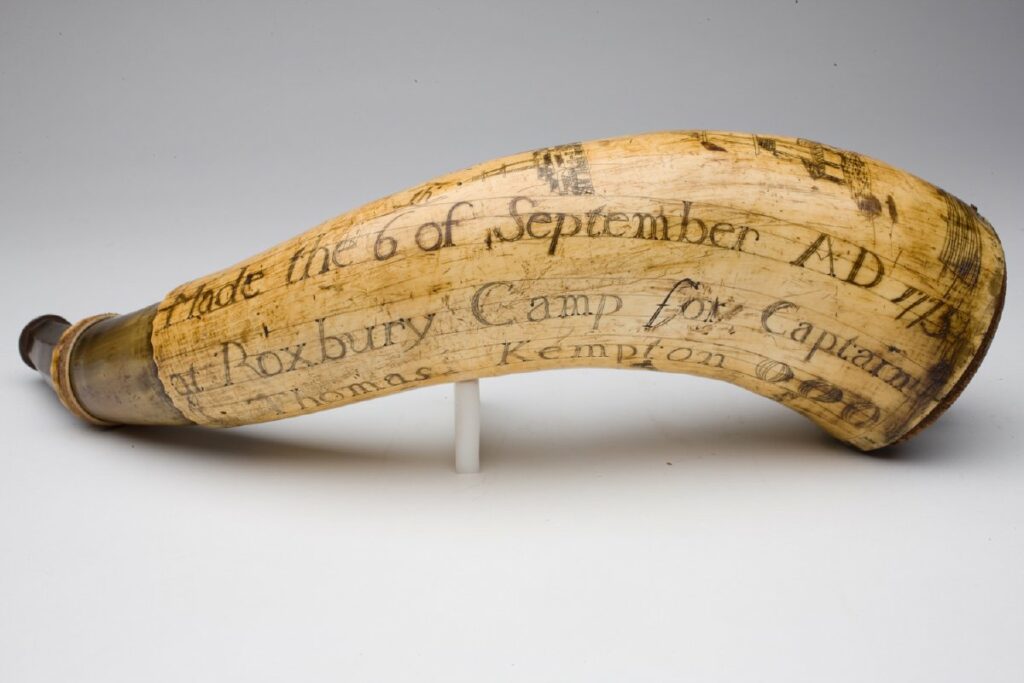
Engraved powder horn made by an unidentified professional carver for Thomas Kempton (1740-1806) of Massachusetts during the Siege of Boston in 1775. Scenes of Roxbury and Boston are engraved on the horn, including the Boston lighthouse, a fort flying the British flag (likely Castle William on an island in the harbor), Boston Neck, and buildings and barracks in Roxbury. American Revolution Institute https://americanrevolutioninstitute.pastperfectonline.com/webobject/7575DEE2-5323-44FD-8B22-102339880923
More on Abner Brownell:
He kept a diary of his travels and preachings which was donated to the American Antiquarian Society by Hannah Brownell in 1919.
A short autobiography written in 1779 provides further details about his life:
Abner Brownell (1756-1851), son of Benjamin and Phoebe Potter Brownell “was born in the Town call’d Dartmouth in Acoakset Village in the County of Bristol, in the State of the Massachusetts Bay in New England.”
He grew up on the family farm on Adamsville Road (known as the Oscar Palmer Farm).
“I was brought up in the observation and attendance for the most part of the Meetings of the People Called Quakers, of which I Lived within about half a Mile of their Meeting house, Call’d the old Meeting house in Acoakset untill I was about Twenty three years of age In which time I was Instructed to Read English, and Something of the Latin Tongue; and Write, and in Arithmetic, as well as a most any of the People of my age, in that part of the Town where I Liv’d.”
Abner was instructed in his father’s trade (tailor). During his youth he worked at his trade in Westport.
His diary describes his reluctant attraction to participating in the conflict which he describes as “the unnatural war, Commenced, Between Great Britain, and North America.”
As a Quaker, Abner Brownell was opposed to war, but as a young man he was equally attracted to “the honour and applause” and possibility of promotion. His participation was limited to a short enlistment “when the Britains took possession of Rhode island.”
And I being a youth, and much persuaded by the Leading People of Hostilities, who Call’d themselves Whigs, or Sons of Liberty, who Diffus’d many things into my head, of the Justness of the Cause, &c; which I Decline mentioning.
(Being entirely to the Reverse, of any ways Joining with a partnership in Political affairs, at this time. But Desiring to be a Subject to that Ruler who teaches and leads all those who perfectly obey him, in the ways of peace, and Quietness.)
But at that time being fond of Seeking the honour and applause of man, and being promis’d to be promoted, (as I had pretty good Learning,) to Some office, I yielded to be Some Assisting in their affairs (though much against my Parents minds) But never went with them in their Campaigns, or in order for an Engagement, But once, which was at an Alarm, when the Britains took possession of Rhode island.
I was with the Americans about a week, but was in no Engagement, and there concluded within myself never to go on Such an occasion again.”
The following year Abner experienced a religious awakening precipitated by :
“a great Pestilence, of the Bloody Flux, (Call’d the Camp Distemper) [dysentery] amongst the Inhabitants; Seeing so much Mortality, and Expecting that Soon it would be my Turn…I Seem’d to have an Earnest Desire in my heart, to Reform my Life.”

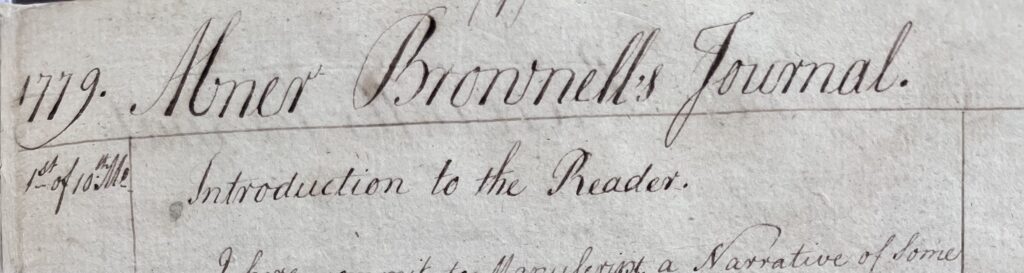
Abner Brownell’s diary 1779, American Antiquarian Society
He soon became an ardent follower of Jemima Wilkinson (1752-1819), the “Public Universal Friend,” and took to travelling throughout southeastern Massachusetts, Rhode Island, and extreme southeastern Connecticut on behalf of the Friends. He was at Groton “the day after the great slaughter at Fort Griswold, when the defenders were killed by the British soldiers and saw the mutilated bodies and attended the funeral of many of the victims.”
Abner returned to Westport, becoming involved in the silkworm industry. In partnership with John Macomber he planted a nursery of mulberry trees on the Macomber farm in Central Village. Read more at www.wpthistory.org/2024/05/risky-business-following-the-threads-of-westports-short-lived-silkworm-enterprise/
Abner Brownell was active in town affairs serving as a justice of the peace, and was entrusted with the drawing of wills and the settling of many estates. He was considered to be an eloquent speaker on religious topics.
He married Hannah Crary (1761-1837) in 1784. Both were buried in the family cemetery at the Oscar Palmer Farm on Adamsville Road, Westport, Mass. They were the parents of ten children as follows:
Dorothy b. June 11, 1785 d. July 4, 1871, unmarried
Nathan Crary b. Jan 28, 1787 d. Jan 8, 1861
Frederick b. Feb 14, 1789 d. April 8, 1872
Fallee b. Oct 14, 1790 d. Jan 10, 1881, unmarried
James Harvey b.Jan 8, 1792 d. Nov 8, 1876
Hannah b. May 24, 1794 d. April 2, 1796
Isaac Watts b. March 19, 1797 d. July 5, 1871
Edward Packer b. Aug 27, 1798 d. December 3, 1875
Ephraim Woodbridge b. June 16, 1802 d. July 31, 1876
Giles Hathaway b. Aug 8,1807 d. July 12, 1808
Information from “Representative Men and Old Families of Rhode Island” Volume 3 published 1908
American Antiquarian Society
Catalog Record #271293
Brownell, Abner, 1756-1851.
Abner Brownell : Diary [manuscript], 1779-1787.
Firstly, to Inform Something of my Birth, Nativity, and Education.
I was Born on the 21st day of the 6th Month, in the year of our Lord, 1756 in the Town call’d Dartmouth in Acoakset Village in the County of Bristol, in the State of the Massachusetts Bay in New England &c.
My Father’s name was Benjamin Brownell, Son of Ichabod Brownell, and Rebeckah his wife.
My Mothers name was Phebe Potter (Before she was married,) Daughter of Nathaniel Potter, and Sarah his wife.
I had one Brother and five Sisters, my oldest Sister’s name was Martha Brownell, who Died before I was born, in her Infancy the Rest were all younger than myself, the Next oldest was my Sister Phebe Brownell, and next to her my Brother Benj: Brownell, and next to him my Sister Sarah Brownell, and Next to her my Sister Mary Brownell and next to her my Sister Esther Brownell.
As to my Education, I was brought up in the observation and attendance for the most part of the Meetings of the People Called Quakers, of which I Lived within about half a Mile of their Meeting house, Call’d the old Meeting house in Acoakset untill I was about Twenty three years of age.
In which time I was Instructed to Read English, and Something of the Latin Tongue; and Write, and in Arithmetic, as well as a most any of the People of my age, in that part of the Town where I Liv’d.
And my Father being by occupation a Taylor, and I being always of a weakly Constitution, I was put to work at that Business, after I was big enough and follow’d it most of my time while I Liv’d with my Father.
In which time I Liv’d the greatest part in a great measure forgetful of my Creator; although many times, I was Visited by the Grace of God, and awakened to a great sence of my State, and Condition; of Living without God in the world:
In many ways, by his providence, by presenting to my views, Instances, of Mortalities, of my fellow mortals.
And many times by his Servants, in my early days amongst the People Call’d Quakers, who were Travellers from Different and remote parts, whom I verily Believe, have been (in the Primitive times of them) Endued with the Spirit from on high, whose doctrine many times was awakening, and Affecting to me.
But by the stratagems, and Insinuations of the Adversary of all Souls; and my yielding to them, I Soon forgot as it were those awakenings, and Resolutions, which Seem’d to be in my mind at those times for to Reform, and live a Christian life.
Thus under that Situation of mind I Seem’d to live untill I was about Twenty years old, though all this time, Living a life of Morality, so call’d in the world, that is, doing nothing that was out of Charater amongst mankind.
But my heart was not given up to Serve the Lord, in Sincerity but a little of this time, when I was about Eighteen years of age, the unnatural war, Commenced, Between Great Britain, and North America;
And I being a youth, and much persuaded by the Leading People of Hostilities, who Call’d themselves Whigs, or Sons of Liberty, who Diffus’d many things into my head, of the Justness of the Cause, &c; which I Decline mentioning.
(Being entirely to the Reverse, of any ways Joining with a partinship in Political affairs, at this time. But Desiring to be a Subject to that Ruler who teaches and leads all those who perfectly obey him, in the ways of peace, and Quietness.)
But at that time being fond of Seeking the honour and applause of man, and being promis’d to be promoted, (as I had pretty good Learning,) to Some office, I yielded to be Some Assisting in their affairs (though much against my Parents minds) But never went with them in their Campaigns, or in order for an Engagement, But once, which was at an Alarm, when the Britains took possession of Rhode island.
I was with the Americans about a week, but was in no Engagement, and there concluded within myself never to go on Such an occasion again.
But not being fully Brought, at that time to See the perniciousness of the thing, as I afterwards was;
The Summer following, there was a great Pestilence, of the Bloody Flux, (Call’d the Camp Distemper) [dysentery] amongst the Inhabitants, Which greatly awaken’d me; Seeing so much Mortality, and Expecting that Soon it would be my Turn.
Which affected me with a concern about my Future State, and being brought to See, that those that would Die the Death of the Righteous, must live the Life of the Righteous, I Seem’d to have an Earnest Desire in my heart, to Reform my Life, and to Join with the People of God, who were Travelling out of Spiritual Egypt into Heavenly Canaan; If I could find them, which caused me to Seek amongst Several Sorts of Professors of Religion, to know for my Self who was in the Right way, that I might Travel with them,
But amongst them all, my Soul could not be Satisfied; for one Sect cry’d lo here this is the way, and another Lo here this is the way…
About the year 1778 I heard of a Remarkable Female Preacher [Jemima Wilkinson], that there was many Reports about I having been under concern of mind, happen’d to meet with her, heard her Improve her Gift in Public she being Very Eloquent in speech, and spoke much of Repentance and Reformation, and of Living a Life of holiness, — I feeling at times under great conviction of Sin, of my lost and undone State she pointing at those things and the Necessity of them I was much Affected and Attach’d with her Doctrine and Set out to Reform and Live uprightly, and Laboured with great Anxiety, and that with Sincerity of Soul for to attain to Such a State, and to Live so as to Procure the Divine Favor, and Blessing of God.
Reflections on Conversion
And the Scales in some Degree seem’d to fall from mine eyes (which was about the Middle of Summer in the Year 1782) And Christ spiritually appear’d to me, as a Glorious Mediator, who had taken upon him humane Nature and has come into the world to Answer the Demands of Gods Law, and had offer’d up his Life to Purchase a Ransom, and here appear’d just Such a Savior as I Needed, wherein God could be just, and yet Save, Such an undone and unworthy Creature, with his Arms Extended as upon the broke[n] [cross]…
Oscar Palmer Farm, a Revolutionary War witness site
ca1700 Stokes Potter house, perhaps the oldest existing house in Westport. The property has passed through ownership of the Potters, Tripps, Brownells and Palmers. During the 20th century this was home to Oscar Palmer and his companion Eleanor Simmons. Today the property is home to Nigerian goats and Norm Anderson and Laurie Marinone. The cemetery represents families connected by marriage: the Brownells and Handys, and the Kirby and Milk families. The 70 marked graves include two Revolutionary War veterans and two War of 1812 veterans.
Pay Roll: Dartmouth Minute Company (April 21, 1775)
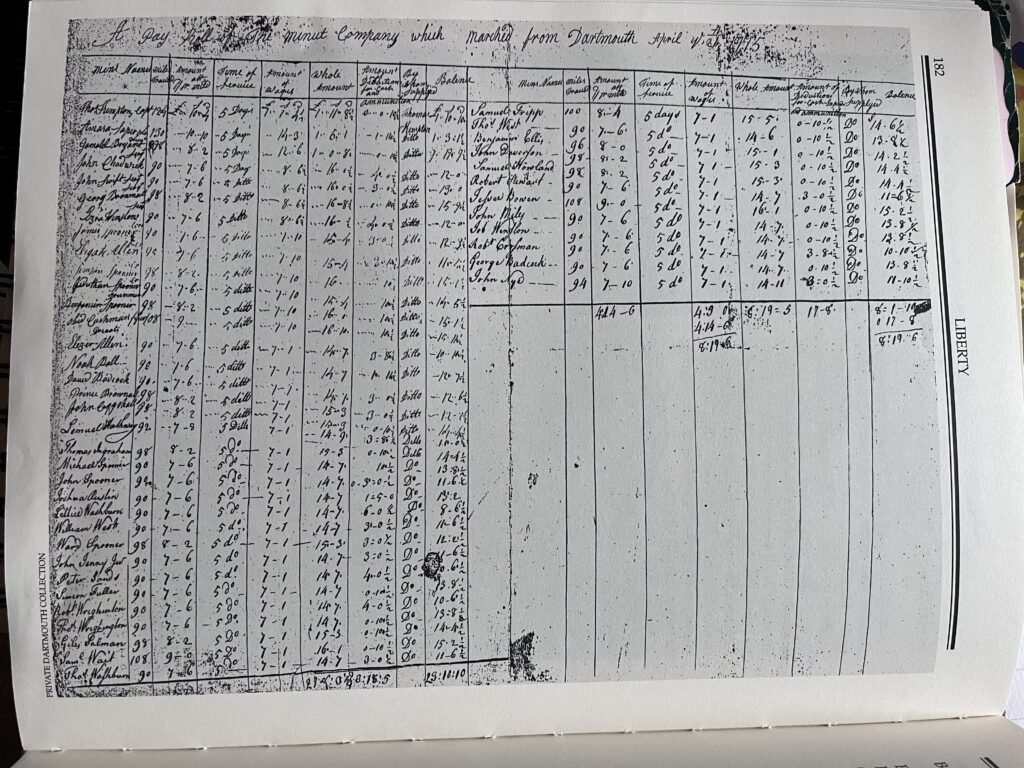
Pay Roll: Dartmouth Minute Company (April 21, 1775) This document is included in Dartmouth The Early History of a Massachusetts Coastal Town by Beverly Glennon, page 182.
This is a full transcription of the names and primary service data from the payroll. Note that “ditto” (or “do”) in the original document refers to the entry immediately above it (usually 5 days of service). Transcribed using Gemini 3, please check for errors.
The currency is recorded in pounds (£), shillings (s), and pence (d).
Travel Distance: You’ll notice the “Miles Travelled” column ranges from 90 to 130 miles. This accounts for the round-trip distance from Dartmouth to the outskirts of Boston.
Wages and Deductions: The men were paid in colonial currency. The “Deductions” column is particularly interesting—it reveals that the town or the army provided them with ammunition and cash for supplies on the road, which was then docked from their final pay.
Pay Roll: Dartmouth Minute Company (April 21, 1775)
| Mens Names | Miles | Amount at 1d | Time of Service | Whole Amount | Balance |
|---|---|---|---|---|---|
| Tho. Kempton, Capt. | 120 | 10-0 | 5 Days | £1-11-8 | £1-10-10 |
| Amasa Soper, Lt. | 130 | 10-10 | 5 Days | 1-5-1 | 1-3-11 |
| Gosnold Bryant | 98 | 8-2 | 5 Days | 1-0-8 | 19-10 |
| John Chadwick | 90 | 7-6 | 5 Day | 16-0 | 12-0 |
| John Swift, | 90 | 7-6 | 5 ditto | 16-0 | 13-0 |
| George Brownell | 98 | 8-2 | 5 ditto | 16-8 | 15-9 |
| Ezra ? | 90 | 7-6 | 5 ditto | 16-1 | 12-0 |
| James Spooner | 90 | 7-6 | 5 ditto | 14-4 | 12-3 |
| Elijah Allen | 90 | 7-6 | 5 ditto | 15-1 | 11-1 |
| ? Spooner | 98 | 8-2 | 5 ditto | 16-8 | 15-11 |
| Jonathan Spooner | 90 | 7-6 | 5 ditto | 14-7 | 14-5 |
| Benjamin Spooner | 98 | 8-2 | 5 ditto | 16-1 | 15-1 |
| Abiel Cushman, | 108 | 9-0 | 5 ditto | 16-10 | 15-11 |
| Eleazer Allen | 90 | 7-6 | 5 ditto | 14-7 | 10-11 |
| Noah Ball | 90 | 7-6 | 5 ditto | 14-7 | 12-7 |
| David Babcock | 90 | 7-6 | 5 ditto | 14-7 | 12-6 |
| Prince Brownell | 98 | 8-2 | 5 ditto | 15-3 | 12-1 |
| John Coggeshell | 98 | 8-2 | 5 ditto | 15-3 | 12-1 |
| Samuel Hathaway | 92 | 7-8 | 5 ditto | 14-9 | 14-0 |
| Thomas Ingraham | 98 | 8-2 | 5 do | 15-3 | 14-4 |
| Michael Spooner | 90 | 7-6 | 5 do | 14-7 | 13-8 |
| John Spooner | 98 | 8-2 | 5 do | 14-7 | 11-6 |
| Joshua Austin | 90 | 7-6 | 5 do | 14-7 | 13-2 |
| Lettice ?Washburn | 90 | 7-6 | 5 do | 14-7 | 8-6 |
| William West | 90 | 7-6 | 5 do | 14-7 | 11-6 |
| Ward Spooner | 98 | 8-2 | 5 do | 15-3 | 12-2 |
| John Jenny Junr. | 90 | 7-6 | 5 do | 14-7 | 11-6 |
| Peter Sands | 90 | 7-6 | 5 do | 14-7 | 10-6 |
| Simon Fuller | 90 | 7-6 | 5 do | 14-7 | 10-6 |
| Robt. Wrightington | 90 | 7-6 | 5 do | 14-7 | 13-8 |
| Thos. Wrightington | 90 | 7-6 | 5 do | 15-3 | 14-4 |
| Giles Tallman | 98 | 8-2 | 5 do | 15-1 | 15-2 |
| Saml. Wait | 108 | 9-0 | 5 do | 16-1 | 11-6 |
| Thos. Washburn | 90 | 7-6 | 5 do | 14-7 | (Bottom cut off) |
| Mens Names | Miles | Amount at 1d | Time of Service | Whole Amount | Balance |
| Samuel Tripp | 100 | 8-4 | 5 days | 15-5 | 14-6 |
| Thos. West | 90 | 7-6 | 5 do | 14-6 | 13-8 |
| Benjamin Ellis | 96 | 8-0 | 5 do | 15-1 | 14-2 |
| John ? | 98 | 8-2 | 5 do | 15-3 | 14-4 |
| Samuel Howland | 98 | 8-2 | 5 do | 15-3 | 14-4 |
| Robert Stewart | 90 | 7-6 | 5 do | 14-7 | 11-6 |
| Jesse Bowen | 108 | 9-0 | 5 do | 16-1 | 15-2 |
| John Wiley | 90 | 7-6 | 5 do | 14-7 | 13-8 |
| Job Winslow | 90 | 7-6 | 5 do | 14-7 | 13-8 |
| Robt. Crosman | 90 | 7-6 | 5 do | 14-7 | 10-10 |
| George Babcock | 90 | 7-6 | 5 do | 14-7 | 13-8 |
| John Nye | 94 | 7-10 | 5 do | 14-11 | 11-10 |
Learn more:
Thomas Kempton Powder Horn
Paul Newman
March 17, 2022
00:02:06
https://www.americanrevolutioninstitute.org/video/thomas-kempton-powder-horn/