
Joseph Allen: Westport blacksmith served in the Continental Army
Posted on March 2, 2026 by Jenny ONeill
By ROBERT BARBOZA
Historical researcher Robert Barboza has written two books about local patriots in the American Revolution. His 2025 book, Patriots of the South Coast, and his 2014 history book, Patriots of Old Dartmouth, are available for purchase at the Westport Historical Society bookstore.
Westport native Joseph Allen was one of the many men from Old Dartmouth (present-day Dartmouth, Westport, Fairhaven, Acushnet and New Bedford) who honorably served the Patriot cause during the Revolutionary War. However, unlike most local men who served with other county militia troops defending their hometowns only when called out for emergency duty, Allen was one of those patriots who spent nearly the entire war in various infantry regiments which were part of the Continental Army.
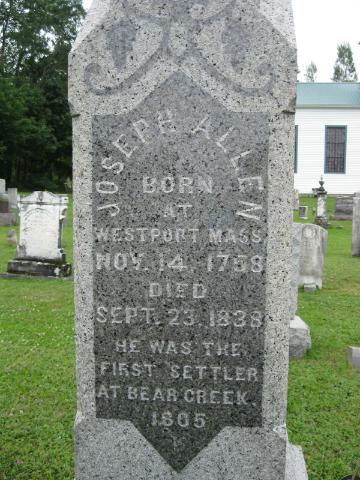
Allen was born on Nov. 14, 1758 in present-day Westport. (He lived on Drift Road.) He signed on as a teenage apprentice to a Providence, RI blacksmith in the nautical trade before the war. About the same time, he would have started drilling with the men of the Acoaxet militia troop, training to be an on-call soldier as required by colonial laws of the time. Not long after, he courted and married Prudence Earle, the daughter of Caleb and Elizabeth Earle.
Apart from his wartime service, the young blacksmith lived in his hometown and practiced his trade locally until he moved to Saratoga County, New York, in 1805. He eventually purchased a large tract of land on Bear Creek, Jefferson County, and established a homestead and a blacksmith shop there. Well known as a businessman, a minister, and a magistrate in that part of rural New York, he ended his days on earth in December of 1843 in Pierrepont, Jefferson County, New York, not far from the Canadian border, now known as Ellisburg.
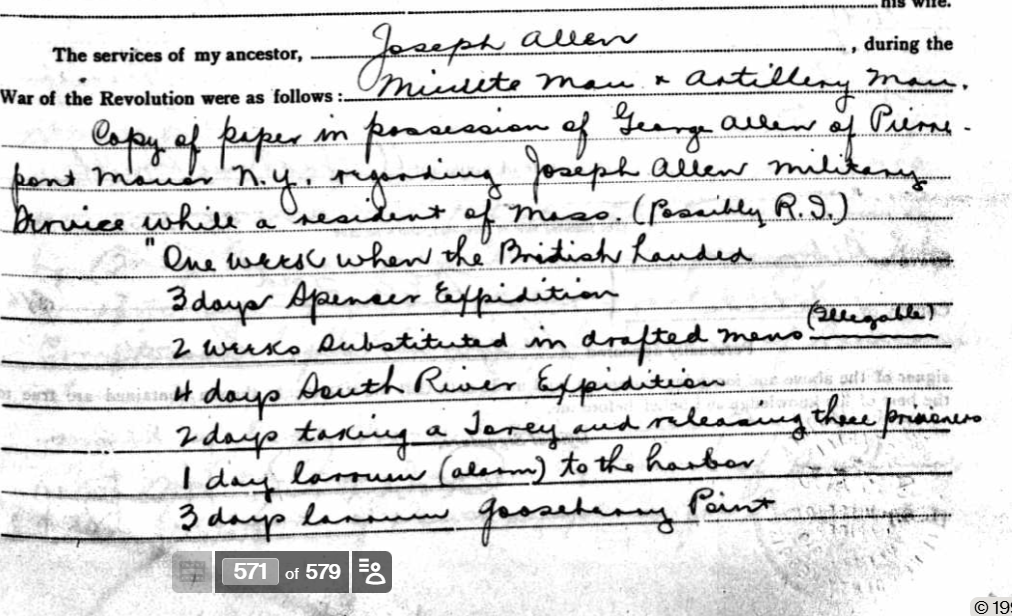
Joseph Allen military service
While the county militia typically served as a coastal defense force occasionally called on to bolster the Continental Army for short terms of enlistment, Allen was one of the rare long-term soldiers in the Continental Army, consecutively serving about six years away from home during the American Revolution. He was only 18 years old when he enlisted on March 14, 1777 as a private in Captain William Ballard’s Company of the 7th Mass. Regiment of Foot, Colonel Ichabod Alden commanding.
Ballard’s company was one of seven Massachusetts volunteer companies recruited in 1776 for federal service. The troops were added to Captain Mayhew’s company from the old 25th Continental Regiment to form a new 7th Massachusetts Regiment. The regiment was first assigned to Northern Department (upstate New York) in February 1777, and then to the Highlands Department (Hudson River area, New York) the following month.
The Massachusetts men were next attached to the 1st Mass. Brigade, serving from June 1777 to March 1778 in the Northern Department, the hottest front of the war in New England. Allen and the 1st Mass. Brigade were at several of the key battles at Saratoga, first on Sept. 19, 1777 at Freeman’s Farm, with General Gates commanding the colonial forces, and later with General Benedict Arnold in charge at Bemis Heights on October 7. The month-long series of battles ended with British General John Burgoyne’s invading army surrounded and badly outnumbered.
Burgoyne’s surrender on October17 gave the Patriot army their first major victory of the war. The greatest outcome was that the defeat of an entire British army encouraged France to formally declare war on England, giving the colonies an important ally in their War for Independence.
Part of the Massachusetts brigade was also stationed at Fort Cherry Valley, site of the infamous Cherry Valley Massacre on Nov. 11, 1778. The British sent 200 Tories and more than 400 Mohawk, Seneca, and other native allies to attack Fort Cherry Valley that fall. The fort was defended by 300 troops from the 7th Mass. Regiment, including several companies from the 1st Mass. Brigade. At least 30 unarmed civilians and 15 soldiers were killed by the British forces in a surprise attack which failed to take the patriot fort, and the raiders retreated the next day back towards Canada.
Military records are a little unclear about what happened to the Massachusetts troops in the following months. The 7th Mass. Regiment was disbanded in early 1779, with the troops were assigned to the New Hampshire Brigade in August, 1779 and then transferred to the 3rd Mass. Brigade in November 1779. Still stationed in New York, Allen and his fellow soldiers found themselves back in the 1st Mass. Brigade again in January of 1781.
The frequent transfers were common as General George Washington was constantly moving his available troops around to fill the outposts along the northern frontier. We do know the company and the brigade was furloughed from active service in June, 1783 at West Point, New York.
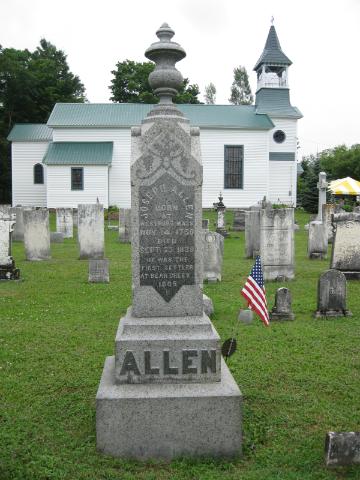
Grave of Joseph Allen, Pierrepont Manor, Jefferson County, New York
Allen and his wartime buddies would have returned home from upstate New York with reports of good farmland available up there at reasonable prices; more than a few planned to return to New York someday if they survived the war. Around the turn of the century, many former soldiers received land grants in the area in lieu of the wartime pay that Massachusetts had never given its most faithful veterans.
Allen was one of many local men who relocated their families to those upstate New York towns where they had served during the war. Some initially went for the free land in the region (and Ohio) offered by the government for their mostly unpaid service with the Continental Army during the war. Many other veterans followed friends and relatives to the lands of opportunity waiting in upper New York and the western frontiers for those who could not afford to buy the more expensive land back in their Massachusetts hometowns.